What Is Agentic AI in Video Surveillance? How Self-Learning Systems Are Changing Enterprise Security
How self-learning CCTV systems make contextual security decisions, reduce false alarms, and automate threat response, without replacing human oversight.
Published by
Content Team
on
Most enterprise surveillance systems are reactive. A camera records. A rule fires when something crosses a line. An operator decides what to do next. The system waits.
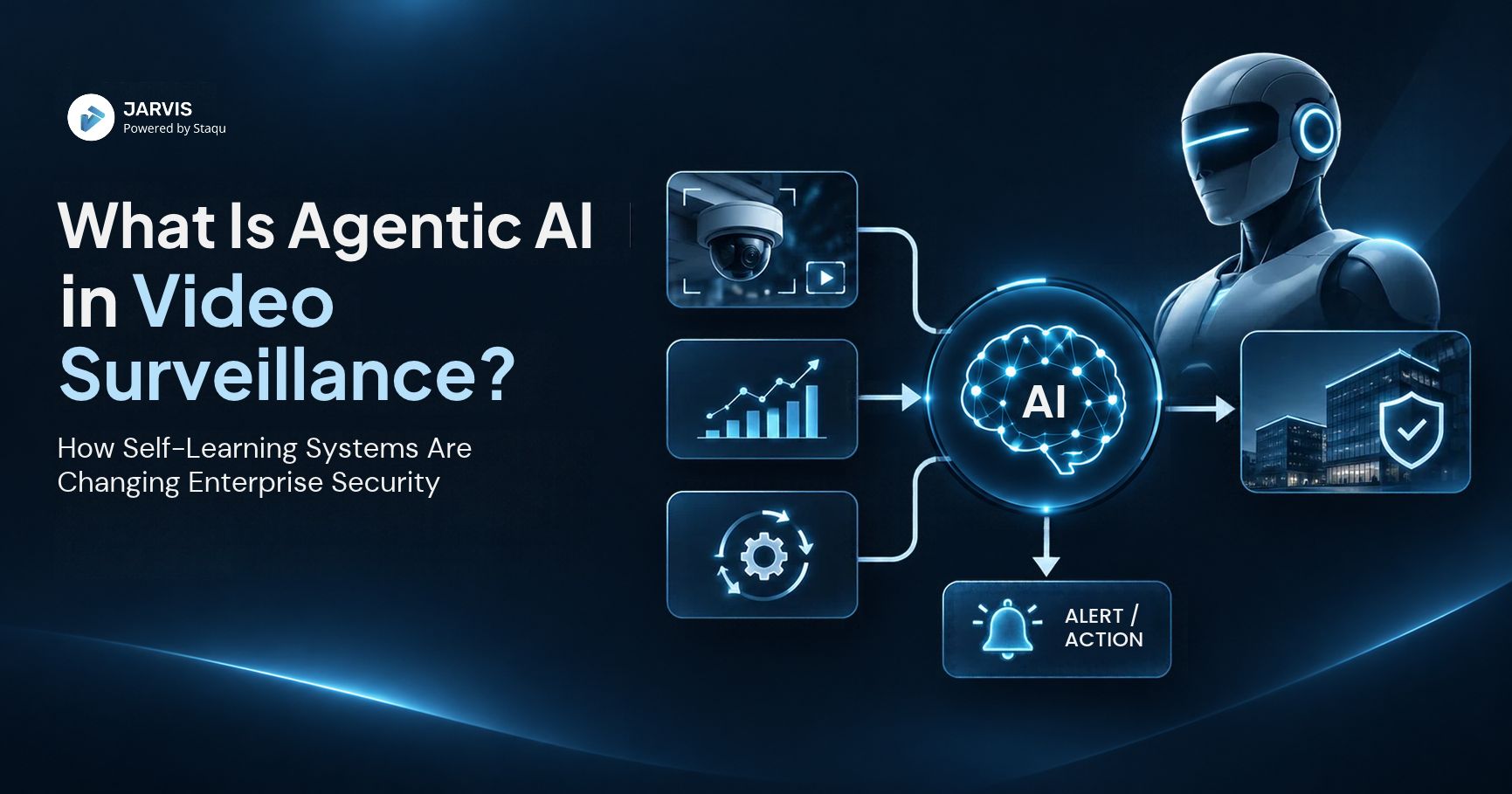
Agentic AI video surveillance works differently. Instead of waiting for a trigger and passing the decision to a human, an agentic system detects a situation, evaluates context, decides on a response, and acts, often before a human operator has seen the alert. That shift from reactive to proactive is what separates agentic AI from conventional video analytics, and it is why the category is attracting serious attention from enterprise security teams managing large, complex physical environments.
JARVIS by Staqu operates in this space, with deployments across retail, government, manufacturing, and hospitality environments in India and internationally. The platform processes camera feeds in real time, applies contextual reasoning across multiple detection layers, and surfaces high-confidence decisions rather than raw alerts.
What Makes a Video Analytics System "Agentic"
The term agentic refers to a system's capacity to act with a degree of autonomy, to pursue a defined goal through a sequence of decisions rather than executing a single fixed rule.
In conventional video analytics, the logic is linear: if X is detected, fire alert Y. The system does not consider whether X is unusual given the time of day, the location, or what happened in the previous ten minutes. It does not adjust its behaviour based on what the alert produced last time. It fires the rule and waits.
An agentic AI system maintains context. It knows that the person currently standing near the server room door has been in that corridor for eleven minutes. It knows that the same zone had three false alerts last week triggered by a cleaning crew. It weighs those factors, decides whether this instance warrants escalation, and routes the output accordingly, whether that is a priority alert, a logged observation, or a suppressed non-event.
This contextual decision-making is what enables agentic AI to reduce false alarms without reducing detection sensitivity. The system learns what matters in each environment and refines its responses accordingly, rather than applying the same threshold uniformly across every camera and every situation.
What if your surveillance system could decide what deserves attention? Book a 15-Minute Demo.
How Autonomous Video Analytics Handles Threat Response
The operational value of agentic AI in surveillance becomes clearest in the threat response sequence.
In a conventional system, the chain runs:
Detection → Alert → Human Review → Decision → Action
Each handoff takes time. In environments where a threat develops in seconds, a perimeter breach, a fire developing in a manufacturing zone, an altercation in a crowded public space, that chain introduces lag at exactly the point where speed matters most.
An agentic AI system compresses the chain. Detection triggers contextual evaluation. If the system determines the situation warrants immediate response, it can execute a defined action, locking a door, escalating to a priority channel, triggering a localised PA announcement, while simultaneously flagging the situation to the relevant human team. The human remains in the loop for decisions that require judgement. Routine escalations that match a high-confidence pattern are handled without waiting for the queue.
This is not automation replacing oversight. It is automation handling the predictable portion of the response so that human attention is reserved for the situations that genuinely require it.
Self-Learning CCTV Systems and Environmental Calibration
A significant source of false alarms in enterprise surveillance is environmental variability. A camera covering an outdoor loading dock at a logistics facility produces very different inputs at 6am, noon, and 2am. A standard rule set calibrated for one time window produces false alerts in others.
Self-learning CCTV systems address this by calibrating to the environment over time. The system observes normal patterns, who moves through each zone, at what times, in what volumes and uses that baseline to distinguish anomalies from expected variation. A forklift moving through a warehouse at 3am is normal. A person in the same zone at the same time, in an area where no person-movement is expected, is not.
This environmental calibration is what makes agentic AI viable for large-scale enterprise deployments. Environments with hundreds of cameras, multiple shift patterns, and varying seasonal footfall cannot be managed through manually configured static rules. A system that learns its own normal baseline and flags deviations is the only practical way to maintain detection accuracy at that scale.
The Honest Risk Assessment
Deploying autonomous AI agents in CCTV networks introduces risks that any enterprise evaluating the technology should consider directly.
The most significant is over-automation, the risk that a system configured to act autonomously takes an incorrect action based on a high-confidence but wrong detection. A door lock triggered by a false positive in an emergency corridor is a safety failure. Agentic AI in security-critical environments requires clearly defined action boundaries, with autonomous response limited to low-consequence actions and human authorisation required for anything that affects physical access, alarms, or personnel response.
The second risk is model drift. A self-learning system that updates its baseline from live data can, over time, calibrate to an abnormal new normal, if the environment changes significantly and the system adapts without oversight, what it flags as anomalous may no longer match what the security team considers a risk. Periodic calibration review is not optional in a well-managed agentic deployment.
As Atul Rai, CEO of Staqu, noted in Mint's coverage of enterprise AI strategy, the question for AI deployment is not whether a model is capable but whether it is deployed in a way that keeps humans meaningfully in the decision loop for the decisions that matter. That principle is what separates a genuinely intelligent surveillance system from one that automates without accountability.
INC42 has tracked how India's AI surveillance sector is moving toward agentic architectures, with enterprise buyers increasingly asking not just what a platform detects but what it does with a detection and how that action is governed.
Frequently Asked Questions
Q1. What is agentic AI in video surveillance and how is it different from traditional analytics?
Traditional video analytics fires a fixed alert when a rule is triggered. Agentic AI evaluates context time, location, history, pattern, before deciding whether to escalate, suppress, or act. The system pursues a security objective through a sequence of decisions rather than executing a single static rule.
Q2. Which video analytics platforms in India use agentic AI to automate security decisions?
JARVIS by Staqu, Hikvision's DeepinMind series, Genetec, and Milestone Systems are among the platforms deploying contextual and autonomous decision-making in enterprise surveillance in India. Platforms differ significantly in how much autonomy they delegate and what governance controls are available to security teams.
Q3. How does agentic AI reduce false alarms in enterprise surveillance systems?
By maintaining a learned baseline for each environment and evaluating detections in context rather than against a static rule. A person near a door at 2am in a zone where no movement is expected is flagged. The same movement during a shift changeover is not. The system calibrates to the environment rather than applying uniform thresholds across every camera.
Q4. What are the risks of deploying autonomous AI agents in CCTV networks?
The primary risks are over-automation, where a high-confidence but incorrect detection triggers a consequential action and model drift, where the system calibrates to a changed environment without oversight. Both are manageable through clear action boundaries, human authorisation requirements for high-consequence decisions, and periodic calibration review.
Q5. Can agentic AI video surveillance work on existing installed cameras?
Yes, when the platform is camera-agnostic. An agentic analytics layer that processes standard video streams connects to existing infrastructure without hardware replacement, so the intelligence upgrade does not require a full camera estate overhaul. This significantly affects the deployment economics for enterprises with large installed bases.
Don't automate blindly. Build surveillance that knows when to act and when to involve a human. Take a 15-Minute Demo.