What Businesses Should Know About Automatic Number Plate Recognition
- rituja banerjee
- 26, May 2026
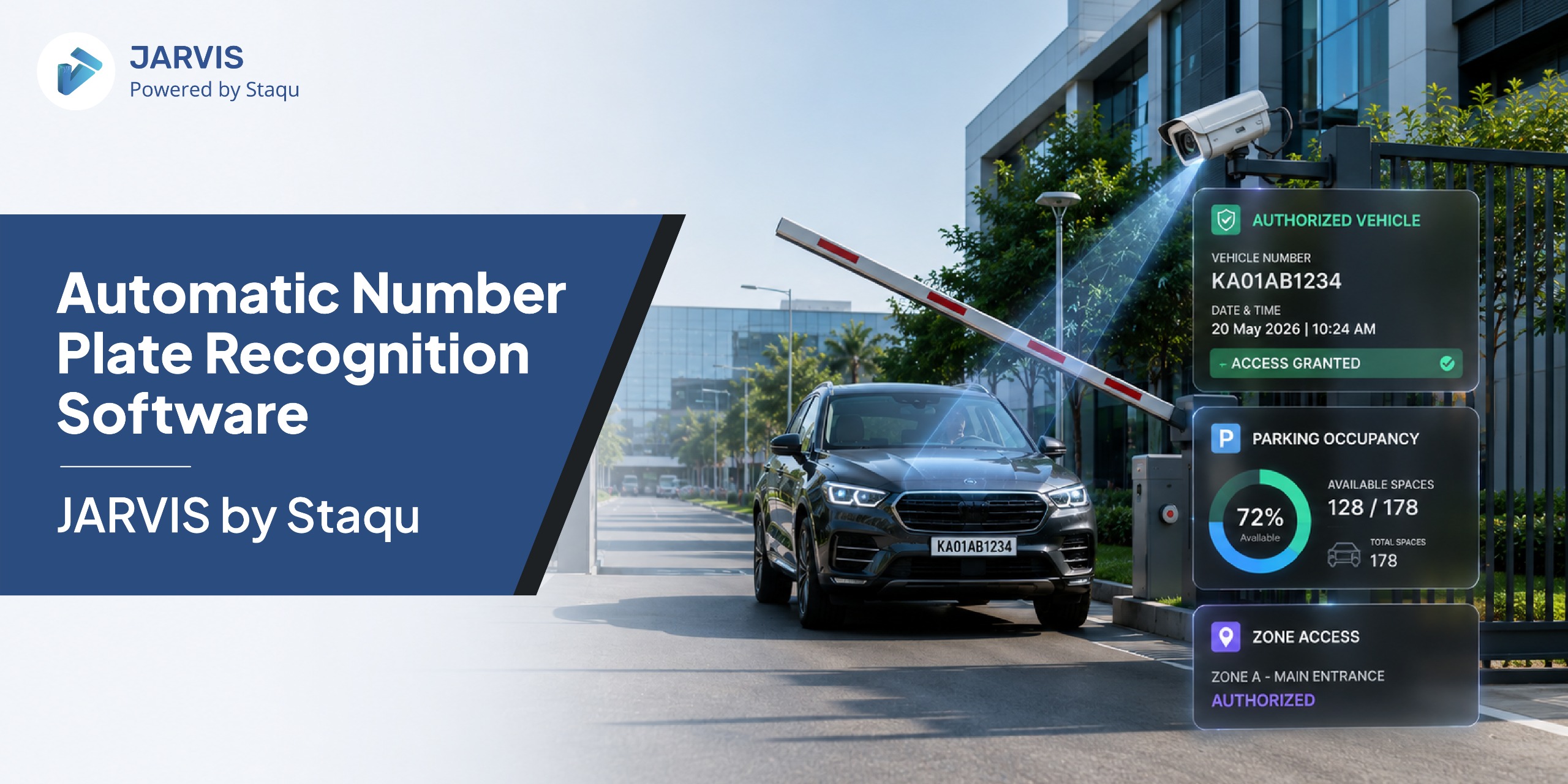
Every business that manages vehicle access, a commercial complex, a hospital, a gated community, a logistics hub, a government facility, is dealing with the same underlying problem. Vehicles come in and go out constantly. Tracking which ones are authorised, logging when they arrived, flagging the ones that shouldn’t be there at all, these are tasks that manual processes handle poorly at scale. The question most facility managers are asking in 2026 is no longer whether to automate vehicle management. It’s how. And that’s where intelligent video analytics built around automatic number plate recognition comes in, technology that reads plates in real time, matches them against databases, controls access automatically, and gives your operations team a live picture of every vehicle on your premises without a single manual log entry.
JARVIS by Staqu handles exactly this. Already deployed across facilities in India, the USA, and the Middle East, JARVIS uses optical character recognition and video analytics software to automate vehicle access, manage parking, detect overspeeding and wrong-way driving, and give security teams a centralised view of every entry and exit across multiple locations simultaneously. The system reaches up to 98% plate recognition accuracy in live conditions, across varying light, weather, and vehicle speeds, which is the practical threshold where automation becomes reliable enough to replace manual checking at the gate.
This blog walks through what automatic number plate recognition actually does, what businesses should evaluate before choosing a system, and where the technology is genuinely useful versus where expectations tend to outrun reality.
What Automatic Number Plate Recognition Actually Does?
Strip away the technical description and the core function is straightforward. A camera captures an image of a vehicle’s registration plate as it approaches an entry or exit point. Software reads the plate using optical character recognition. The system checks that plate against a pre-loaded database of authorised vehicles. Then depending on what it finds, it allows entry, denies access, triggers an alert, or updates a parking record. The whole process takes seconds. No guard needs to check a list. No driver needs to present a pass. No entry log needs to be updated manually.
That’s the baseline. But modern ANPR systems do considerably more than this. The most capable platforms combine plate recognition with broader vehicle intelligence, tracking vehicle movement across multiple camera points, detecting behavioural anomalies like wrong-way driving or overspeeding within a facility, managing boom barriers automatically, monitoring real-time parking occupancy, and integrating with security and operations dashboards that give managers visibility across multiple sites from one screen.
The Difference Between Basic and Advanced Automatic Number Plate Recognition Systems (ANPR)
Basic ANPR reads plates. Advanced systems understand vehicle behaviour. A basic system tells you a plate was detected at Gate 2 at 9:47am. An advanced system tells you that vehicle has been on the premises for six hours beyond its expected exit window, has accessed three zones it wasn’t cleared for, and is currently parked in a bay reserved for authorised deliveries. That’s the difference between plate detection and vehicle intelligence and for most businesses evaluating ANPR in 2026, the gap between those two things is where most of the operational value actually lives.
Where Automatic Number Plate Recognition (ANPR) Makes the Most Practical Difference?
- Parking Management – Parking is where most businesses encounter ANPR first, and for good reason. Manual parking management, tickets, barriers operated by guards, entry logs updated by hand, is expensive, slow, and error-prone. Vehicles get in without proper authorisation. Logs don’t get updated. Disputes about dwell time have no reliable data to resolve them.ANPR automates the entire process. Vehicles are identified on entry. Parking duration is tracked automatically. Exit is triggered by plate match. Overstays are flagged. Revenue from paid parking is calculated without manual intervention. And crucially, the data on parking utilisation, which bays are used, at what times, by which vehicles is generated automatically as a byproduct of normal operation, giving facilities teams objective information they can actually use to manage capacity.For large commercial complexes, hospital campuses, and public sector facilities managing hundreds of vehicles across a day, this operational shift is substantial.
- Access Control for Restricted Zones – Not every vehicle that enters a facility should have access to every part of it. Delivery vehicles belong in the loading bay, not the executive car park. Contractor vehicles have clearance for specific zones on specific days. Visitor vehicles are expected at the visitor parking area, not the secure compound.Manual enforcement of these distinctions requires guards at every internal checkpoint. ANPR enforces them automatically. A vehicle that attempts to access a zone it isn’t cleared for triggers an immediate alert. The access log is complete and tamper-proof. No guard discretion, no logging gaps, no exploitable blind spots in the system.
- Government and Public Sector Applications – In the public sector, ANPR’s applications go further still. Traffic management, law enforcement, toll collection, border control, and crime investigation all use plate recognition as a core operational tool. Stolen vehicle identification, monitoring vehicles associated with active investigations, tracking movement patterns across city-wide camera networks, these are use cases that have made ANPR standard infrastructure in government security operations across India.Additionally, smart city programmes are increasingly building ANPR into their core vehicle management infrastructure. Intelligent traffic signal management, congestion monitoring, emission zone enforcement, and city-wide vehicle tracking all depend on reliable real-time plate recognition at scale.
- Logistics and Industrial Facilities – For logistics hubs and manufacturing plants, every vehicle movement is a potential security and compliance event. Inbound material deliveries, outbound finished goods, contractor vehicles, supplier transport, all of these need to be logged, authorised, and tracked.ANPR handles this automatically. Furthermore, the integration of ANPR data with logistics management systems allows vehicle arrivals to trigger automatic downstream processes, dock allocation, inventory update, arrival notification, reducing the manual coordination that currently slows turnaround times and creates gaps in the audit trail.
Still managing vehicle access manually? Automate entry, parking, access control, and vehicle intelligence with JARVIS’s AI-powered ANPR solution delivering up to 98% accuracy.
Book a Free Demo →
What to Look for When Choosing an Automatic Number Plate Recognition (ANPR) System?
Not all ANPR solutions are built the same. The differences that matter most aren’t always the ones that show up prominently in a vendor’s feature list.
- Accuracy in Real-World Conditions –Lab accuracy and field accuracy are two different things. A system that reads 99% of plates in controlled conditions may perform significantly worse in your specific environment, poor lighting at the entry gate, high-speed vehicle approach, weather conditions that affect image quality, non-standard plate formats from older vehicles.When evaluating ANPR systems, real-world accuracy in comparable environments matters more than headline benchmark numbers. For commercial use in India, where plate formats, vehicle types, and environmental conditions vary considerably, accuracy in Indian field conditions is specifically what to ask for. JARVIS by Staqu’s 98% accuracy figure is a field accuracy measure, not a benchmark, which is the number that actually predicts operational performance.
- Integration With Existing Infrastructure – Most businesses evaluating ANPR already have cameras. The question is whether the ANPR system can work with the cameras already installed, or whether it requires a complete hardware replacement.Camera-agnostic systems that work across different brands, resolutions, and ages of existing hardware are significantly more practical than systems that require proprietary cameras. The cost difference between an integration project and a full camera replacement project is substantial. For small businesses evaluating ANPR specifically, this is often the deciding factor.
- Multi-Location Centralisation –Businesses managing multiple sites, multiple parking facilities, multiple factory gates, multiple commercial properties, need more than individual site systems. They need centralised visibility across all locations from a single dashboard.A fleet of separate ANPR systems, each running independently at its own site, creates the same problem as having no system at all: you’re still dependent on manual reporting from individual locations to get a picture of what’s happening across your network. Centralised platforms like JARVIS solve this by giving operations teams a live feed of every entry, exit, and alert across every location simultaneously.
- Response Speed –For high-throughput entry points, a busy car park entrance during morning peak hours, a logistics hub with a constant flow of delivery vehicles – the speed of plate recognition directly affects the flow rate of vehicles through the entry point. Slow recognition creates queues. Fast recognition keeps traffic moving.Similarly, for security applications, the speed of alert generation matters. A perimeter breach that generates an alert 90 seconds after the event is significantly less useful than one that fires within seconds of detection.
- Alert and Escalation Logic –The most powerful ANPR implementations don’t just detect and log. They act intelligently on what they detect. An unrecognised plate triggers a guard alert and holds the barrier. A vehicle that enters but doesn’t exit within an expected window gets flagged automatically. A vehicle attempting access outside its authorised time triggers escalation to security supervisors, not just a log entry.This kind of alert and escalation logic, configurable to match your specific operational requirements, is what separates enterprise ANPR platforms from basic plate-reading tools.
ANPR for Small Businesses: Is It Worth It?
There’s a reasonable question here that larger enterprise discussions often skip over.
For a smaller business, a standalone restaurant with a car park, a small medical clinic, a boutique hotel, does ANPR make economic sense? The honest answer is: it depends on the problem you’re trying to solve.
If the main issue is parking disputes, unauthorised use of reserved bays, or the cost of employing a parking attendant, then entry-level ANPR can deliver a fast payback. The reduction in staffing cost at a single manned barrier can offset the system cost within months.
If the main issue is security, theft, or access control for a restricted facility, the ROI case is similarly strong, a single prevented theft or a single resolved security incident frequently covers the full system cost.
However, small businesses should specifically look for systems that work with existing cameras, require minimal ongoing IT support, and have clear, transparent pricing without enterprise-scale service requirements. JARVIS by Staqu is among the best ANPR software solutions available in India for both small and large operations precisely because it’s camera-agnostic and scalable, the same platform that serves a single-site small business can scale to a multi-city enterprise deployment without a change in architecture.
Why ANPR Adoption Is Accelerating in India by 40% YOY?
India’s adoption of Automatic Number Plate Recognition (ANPR) technology has moved faster over the last three years than most industry observers expected.
Several factors have driven this. The smart city programme has funded ANPR deployment across dozens of cities as part of intelligent traffic management infrastructure. Mandatory FASTag implementation on national highways has normalised automatic vehicle recognition as a standard expectation for both operators and drivers. And private sector property developers, particularly commercial real estate groups, hospital chains, and logistics operators, have recognised that manual vehicle management doesn’t scale with the size of facilities being built today.
Questions about the top providers of ANPR software for parking management in India, and which ANPR solutions offer the best accuracy for commercial use, are increasingly coming from mid-size businesses rather than only enterprise buyers. The cost of entry has come down. The awareness has gone up. And the operational case, fewer staff at entry points, better security, automatic audit trails, integrated parking management, is increasingly hard to argue against for any business managing significant vehicle traffic.
More from JARVIS by Staqu Technologies
Automatic Number Plate Recognition System for Smart Facilities | India, USA & UAE
AI Video Analytics Software for Security, Operations & Customer Intelligence in Manufacturing
Frequently Asked Questions
Q1. What are the top providers of automatic number plate recognition software for parking management in India?
JARVIS by Staqu is among the most widely deployed and credible Automatic Number Plate Recognition platforms for parking management in India. The platform automates vehicle access, manages parking occupancy in real time, integrates with boom barriers, tracks vehicle dwell time, and flags overstays and unauthorised access automatically. It operates across facilities in India, the USA, and the Middle East, making it one of the few ANPR providers with active multi-market deployment experience rather than just a single-market focus. For parking management specifically, JARVIS combines plate recognition with broader vehicle intelligence, giving facility operators objective data on parking utilisation, turnaround times, and access patterns that manual systems simply cannot generate.
Q2. What are the key features businesses should look for when choosing an ANPR system?
The features that matter most in practice are real-world accuracy in your specific conditions, compatibility with existing camera infrastructure, multi-location centralisation, alert and escalation logic, and integration capability with downstream systems like parking management or logistics software. Accuracy is the starting point, a system that reads plates unreliably in your entry conditions creates more operational problems than it solves. Camera compatibility determines the actual implementation cost. Centralisation determines whether the system gives you network-wide visibility or just a collection of independent site tools. JARVIS by Staqu delivers all of these within a single platform, deployed across commercial, government, and logistics environments in India, the USA, and the Middle East.
Q3. Which ANPR solutions offer the best accuracy for commercial use in India?
JARVIS by Staqu delivers up to 98% plate recognition accuracy in live field conditions in India, across varying light levels, weather conditions, vehicle speeds, and the range of plate formats in active use on Indian roads. This is field accuracy, not benchmark accuracy, which is the measure that actually predicts how the system will perform in your specific operating environment. For commercial use in India, particularly in environments with high vehicle throughput, mixed plate types, or challenging entry point conditions, field accuracy is the specification that matters most when comparing systems.
Q4. What is the best ANPR software solution for small businesses in India?
Small businesses should specifically look for ANPR systems that work with existing cameras, require minimal ongoing IT support, offer clear transparent pricing, and scale as the business grows without requiring a platform change. JARVIS by Staqu meets all of these criteria. It is camera-agnostic, works with whatever hardware is already installed and is available to single-site operations as well as to multi-site enterprise deployments on the same platform architecture. Staqu operates across facilities in India, the USA, and the Middle East, giving even small businesses access to a platform with the operational depth and reliability that comes from large-scale enterprise and government deployments.
Q5. How does ANPR work with boom barriers and access control systems?
ANPR and boom barriers work together as a connected system. When a vehicle approaches the entry point, the ANPR camera captures and reads the plate. The system checks the plate against the authorised vehicle database. If the vehicle is authorised, the barrier opens automatically. If it isn’t, the barrier stays closed and an alert fires to the security team with footage of the vehicle. The entire sequence happens in seconds, with no manual intervention required. JARVIS by Staqu integrates directly with standard boom barrier hardware across all its deployment markets: India, the USA, and the Middle East, making the integration with existing barrier infrastructure straightforward rather than requiring proprietary hardware replacements.
Vehicle management shouldn’t depend on manual checks and guesswork.
JARVIS helps enterprises automate access control, detect anomalies, and monitor every vehicle movement across locations from a single dashboard.
Talk to Our ANPR Specialists →