What Your Store Saw Today That You Didn’t

At the end of most shifts, retail and F&B operators do the same thing, pull up the day’s revenue, see if it moved, and call it done.
It is a reasonable habit. But it leaves a lot unexamined. Between opening and closing, the store floor generates information that no POS report will ever surface. Which zone customers walked into and then abandoned? How long did the queue run before people started dropping off ? Whether the back section saw any meaningful traffic at all. Where staff were, and weren’t, during the busiest hour of the day. This information exists. The cameras have been recording it. The gap is that most businesses have no way to actually read it, even when they believe they have the best security camera system inplace.
And that gap is not small. Every understaffed peak hour, every section of the store that customers consistently skip, every checkout line that runs too long without anyone noticing, it all compounds quietly. Day after day, the footage captures it. Day after day, it goes unread.
The Best Security Camera System Does More Than Record
The original brief for a camera system was straightforward: capture footage, store it, retrieve it when something goes wrong. For years, that was the standard. Image clarity, storage capacity, and lens range, these defined what good video surveillance solutions were expected to deliver.
That standard has shifted. The top security camera system today is not evaluated on hardware specifications alone. It is evaluated on what it can tell you ,about customer behavior, staff deployment, layout efficiency, and revenue leakage that compounds quietly over weeks and months. The owners who get it aren’t just running cameras to protect their stores, they’re running them to understand what’s actually happening inside. They are using them to run better operations powered by AI video analytics layered onto their infrastructure.
The shift does not require new hardware or a bigger tech budget. It requires the right intelligence layer running on top of what is already installed, turning footage that was never being used into decisions that get made faster and with more confidence.
What a Normal Day Looks Like When You Can Actually See It
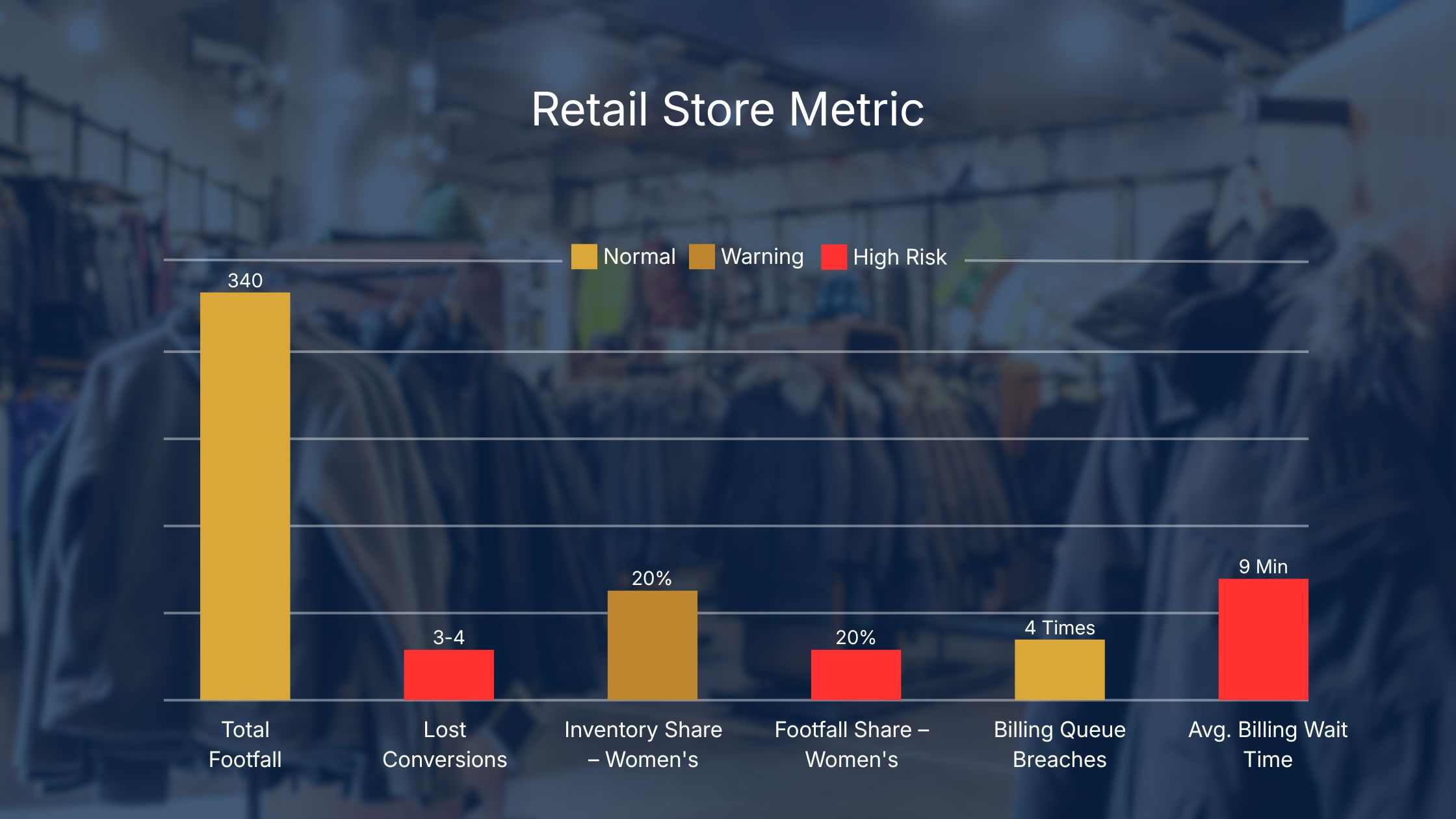
Take a retail store on an unremarkable Wednesday. Here is what the operator knows by end of day when running JARVIS:
Footfall was unique to visitors. Peak traffic landed between but only staff members were on the floor during that window, a gap that likely cost conversions. The women’s section in the back, despite holding nearly all of the store’s inventory, drew less than total footfall. The billing queue crossed people deep times, with average waits of minutes, long enough for customers to walk. None of this required a new camera nor someone to manually review footage. It came from the same infrastructure already in place, with smart video analytics running on top of existing video surveillance solutions.
F&B operators gain the same kind of visibility. How tables turned across shifts, what each counter moved in orders, and whether staff held to protocol, with any slip flagged immediately rather than showing up in a report nobody reads until Thursday. This is AI video analytics working in real time. For multi-location operators, that real-time visibility runs simultaneously across every outlet from a single centralized view. There is no need to be physically present at each location to know what is happening. The data comes to you, structured, timestamped, and tied directly to the decisions that shape how the next shift runs.
JARVIS: AI Video Analytics Built on What You Already Have
JARVIS connects to existing cameras, DVRs, and NVRs. No hardware swap, no drawn-out onboarding , from connection to first insight, setup takes around 30 minutes. As one of the most practical video surveillance solutions available today, it does what traditional systems were never designed to do: turn recorded footage into structured, real-time operational intelligence.
For retail, JARVIS tracks visitor counts, movement heat maps, dwell times, queue wait times, demographic breakdowns, customer journey paths, and POS-correlated loss prevention data. Metro Brands, India’s largest listed footwear retailer, cut operational expenses by 23% after deployment. Not by spending more, but by finally being able to see what was happening on their floors.
For F&B businesses, JARVIS maintains visibility across every outlet, tracking staff compliance, monitoring queue pressure during peak hours, and triggering alerts the moment operations begin to slip, well before the shift comes to an end. Even the best security camera system becomes significantly more powerful when paired with intelligent analytics. Everything feeds into a centralized dashboard. Alerts are escalated to the right person. The data integrates with existing reporting tools so it actually gets used, not archived and forgotten.
Rethinking What the Best Security Camera System Should Do
There is a version of store management that runs almost entirely on instinct and incomplete data, and it works, up to a point. The longer it runs that way, though, the more ground it quietly gives up. The operators pulling ahead are those who have closed the gap between what they know and what their store knows.
Investing in the best security camera system no longer means choosing between security and operational insight. With AI video analytics, the same infrastructure delivers both, protecting the business while simultaneously generating the data needed to improve it.
The businesses pulling ahead right now are not always the ones with the largest teams or the biggest floor space. They are the ones who stopped flying blind and started making decisions based on what is actually happening inside their stores every single day.
Your cameras have been watching. JARVIS makes sure you are watching with them. See what your store has been telling you.
Frequently Asked Questions
1. Does JARVIS require new cameras or additional hardware?
No. JARVIS connects through existing DVR or NVR systems without any hardware replacement or rewiring. There is no complex installation process, most businesses are fully up and running within 30 minutes of the initial connection.
2. How is AI video analytics different from standard CCTV footage?
Standard CCTV captures footage passively and stores it for later retrieval. AI video analytics processes that same footage in real time, continuously flagging customer movement patterns, staff compliance gaps, and checkout queue build-up before the window to act has already closed.
3. Can JARVIS manage multiple store locations from one place?
Yes. JARVIS consolidates live feeds from every location into a single centralized dashboard. Alerts are structured and routed to the right person automatically, regardless of how many outlets are part of the network.
4. What kinds of businesses benefit most from retail video analytics?
Any business that runs on physical foot traffic, retail stores, restaurant chains, cafés, and multi-location franchise operations where customer volume, staff deployment, and floor layout directly shape revenue outcomes.
5. How quickly does JARVIS start delivering usable insights?
Within approximately 30 minutes of connection. There is no lengthy onboarding cycle, and all data integrates directly with existing reporting tools already in use across the business.