How AI Queue Management Systems Reduce Wait Times and Improve Customer Experience in Your Stadium
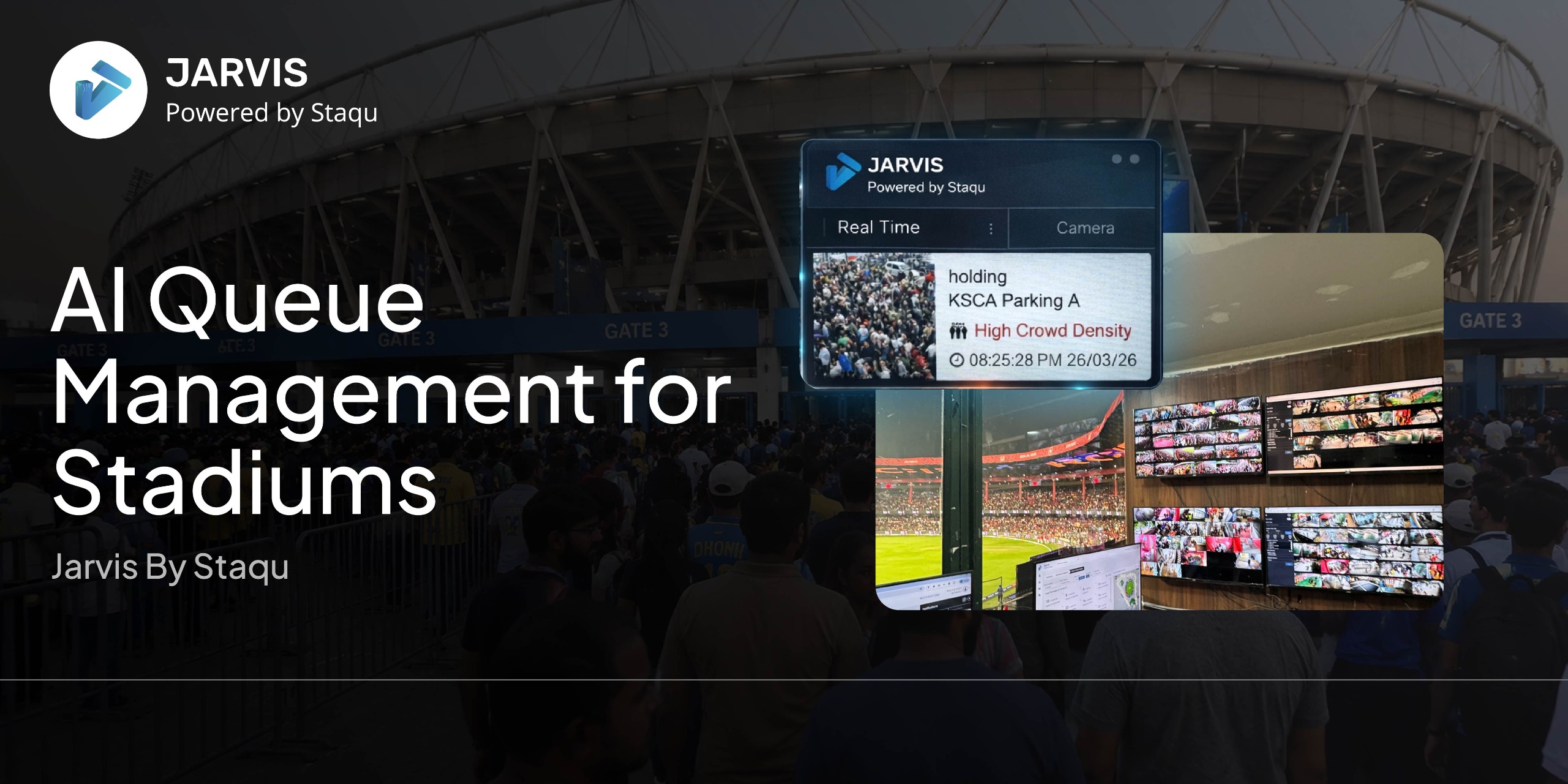
You know you’ve put enormous effort into your stadium. The pitch is immaculate. The food vendors are stocked. The screens are high-definition. The matchday atmosphere, on a good day, is electric. And yet, somewhere between the parking lot and the seat, something keeps going wrong. Fans arrive excited and walk in frustrated. The reviews mention it. Your operations team hears about it. And you already know exactly what it is, your queue management system which isn’t keeping up. Or worse, you don’t have one smart enough to handle the scale of what match day actually looks like.
It’s not a glamorous problem, but it is one of the most consequential ones you face as a stadium owner. The good news? A solution exists and it doesn’t require tearing your venue apart to get there. JARVIS by Staqu, one of India’s most trusted AI-powered video analytics platforms, is already helping large venues transform the way they manage crowds, entry flows, and fan experience by making the cameras you already have dramatically smarter. This blog walks you through exactly how it works, why it matters for your bottom line, and what getting started actually looks like.
Why Your Queue Problem Is Bigger Than You Think?
Here’s a number worth sitting with: research across large event venues consistently shows that fans who experience a wait of more than 20 minutes at entry are significantly less likely to return for the next event. Not a little less likely. Significantly.
Your matchday revenue model has multiple layers, ticket sales, food and beverage, merchandise, sponsor activations, future season ticket renewals. Every single one of those revenue streams is directly impacted by the quality of the fan entry experience. A fan who spends 40 minutes in a chaotic queue under the afternoon sun isn’t in the right headspace to browse your merchandise store. They’re not stopping at the food court. They’re getting to their seat as fast as possible, opening their phone, and venting on social media.
And that’s the scenario where everything goes reasonably well. Because the other scenario, the one no stadium owner wants to think about but all of them must, is when an unmanaged crowd surge at an entry gate becomes a safety incident. Dense, uncontrolled queues at high-footfall venues are a genuine public safety risk. The human cost of getting this wrong is something no amount of insurance covers adequately.
So when we talk about solving the queue problem, we’re not talking about a nicety. We’re talking about protecting your revenue, your reputation, and your fans.
What Traditional Queue Management Gets Wrong?
If you’re currently managing entry queues with a combination of physical barriers, entry staff, and experience-based intuition, you’re doing what most stadiums do. And you already know its limitations.
Your staff can only observe what they can see from where they’re standing. They can’t simultaneously monitor Gate 1 and Gate 7. They can’t tell whether the queue building outside Section C is going to resolve itself in five minutes or balloon into a dangerous crush in fifteen. They react to what’s already visible, which means by the time a problem is noticeable to a human observer, it’s already developed.
And after the event, what data do you have? Some incident reports. A few anecdotal observations from your team. Maybe some rough headcount numbers. Nothing that tells you definitively where the bottlenecks formed, at what time, triggered by what crowd behaviour, and what you should do differently next time.
Traditional queue management is reactive, labour-intensive, and data-poor. That’s not a criticism of your team, it’s a structural limitation of the approach. And it’s precisely the gap that AI-based systems are built to fill.
What an AI Queue Management System Actually Does for You?
Think of an AI queue management system as giving your operations team eyes everywhere, all the time, eyes that never get tired, never get distracted, and can process what they’re seeing into actionable information instantly.
Here’s what it does in practice:
- Continuous Queue Monitoring Across Your Entire Venue
AI-enabled cameras watch every entry gate, every checkpoint, every food court queue, every restroom corridor, simultaneously. The system measures queue lengths in real time, not based on someone walking around to check, but automatically, from the camera feeds you already have installed. - Live Crowd Density Mapping
At any given moment, you can see exactly where your crowd is concentrated and where there’s open space. This isn’t just useful for managing entry, it’s operationally valuable across the entire fan journey. If Gate 3 is overwhelmed and Gate 6 has capacity, your team can redirect fans immediately rather than waiting for Gate 3 to become a crisis. - Proactive Surge Alerts
This is where AI genuinely changes the game for stadium safety. The moment crowd density at a specific point starts trending toward dangerous levels, your operations command centre receives an alert. Not after the surge has happened. As it’s building. That gives your team the window to respond, open additional lanes, redirect incoming crowds, deploy staff, before the situation becomes unmanageable. - Post-Event Analytics That Actually Help You Improve
After every event, you get detailed data: where queues formed, when, how long they lasted, which gates were underutilised, which points were consistently problematic. This is the insight layer that turns your next event into a better operation than your last one. Over time, you’re not just managing queues, you’re redesigning your crowd flow strategy based on real evidence.
Book a 15-Minute JARVIS Demo to see how JARVIS improves stadium entry, reduces queue chaos, and enhances crowd safety using existing CCTV infrastructure →
The JARVIS Advantage: Built for Venues Like Yours
When stadium operators and large venue managers in India are looking at AI surveillance and analytics solutions, one name that comes up consistently in that conversation is JARVIS by Staqu Technologies.
Staqu Technologies is one of the leading AI CCTV analytics companies in India, and JARVIS is their flagship platform, an AI-powered audio and video analytics system that converts your existing CCTV cameras into an intelligent venue management layer. It’s been deployed across large-scale, high-stakes environments: public infrastructure, smart city projects, correctional facilities managing thousands of people across dozens of locations simultaneously. The platform knows how to handle complexity, density, and real-time pressure.
For stadium operators specifically, the most important thing to understand about JARVIS is this: you do not need to replace your existing camera infrastructure. JARVIS integrates with what you already have. Your current CCTV setup becomes the sensor network. JARVIS becomes the brain that makes sense of everything those cameras are seeing.
Your operations team gets a centralised dashboard, a single unified view of your entire venue, all gates, all zones, all checkpoints, with real-time alerts and crowd analytics. Instead of your command centre cycling through individual camera feeds and hoping someone spots a problem, the system surfaces the problem to you automatically.
That’s a fundamental shift in how you run matchday operations.
The Fan Experience Returns: What Your Numbers Will Tell You?
Let’s talk about what happens to your business metrics when queue management genuinely improves.
- Dwell Time Increases
When fans get through entry quickly, they have more time inside your venue before kickoff. That time has value. It’s spent at concession stands, at merchandise counters, at sponsor activation zones. Venues that have successfully reduced entry wait times consistently report increases in per-fan spend, because the fan has more time and is in a better emotional state when they arrive at their seat. - Social Sentiment Improves
Matchday social media is a real-time barometer of fan experience. Right now, if you search your stadium’s name on social media on a matchday, how many of the posts are about the queue? That’s a metric you can genuinely move with better entry management and the downstream impact on your brand and on future ticket demand is measurable. - Season Ticket Renewal Rates Strengthen
Your most valuable fans are your season ticket holders. They come to every game. They know every pain point in your venue better than anyone. When you fix the queue problem, they notice. And when renewal time comes, that improvement factors into their decision. Retention of your season ticket base is one of the most efficient revenue levers you have. - Safety Incident Risk Drops
This one isn’t a revenue metric, but it belongs in any honest conversation about stadium ROI. A serious crowd safety incident has consequences that extend far beyond the immediate event, regulatory scrutiny, reputational damage, potential legal liability, and the psychological impact on your staff and fan community. Proactive AI-based crowd monitoring is one of the most effective risk mitigation investments a stadium operator can make.
Not Just the Entry Gate: Where Else This Transforms Your Operations?
Your entry gate is the most visible pressure point, but once you have an intelligent monitoring system in place, the applications multiply.
- Food and Beverage Operations
Long queues at concession stands are one of the top fan complaints at sporting events globally, and they’re also a direct revenue leak for you. AI monitoring tells you in real time which stalls have overwhelming demand and which have capacity. You can redirect fans through signage, dynamically reassign staff, and use the historical data to plan your concession staffing and inventory far more accurately for future events. - Restroom Management
Halftime restroom bottlenecks are a genuine crowd management challenge at high-attendance venues. AI monitoring of queue density outside restroom facilities allows your facilities team to respond quickly, whether that means temporary resource reallocation or simply adjusting crowd flow in surrounding corridors. - VIP and Premium Access
For your premium ticketing tiers, queue experience is part of what they’re paying for. AI-managed premium access points deliver the frictionless entry experience that high-value fans expect and that justifies premium pricing. - Exit Management
Getting your entire crowd out safely and efficiently after the final whistle is an underappreciated operational challenge. AI-driven exit flow monitoring helps prevent post-event bottlenecks, coordinates with your security team on gate sequencing, and can integrate with broader traffic and transport management to improve the overall departure experience. - Retail and Merchandise Zones
Knowing which merchandise zones are crowded versus available in real time allows your retail team to redirect fans and maximise sales across your venue footprint.
What Implementation Actually Looks Like?
A question we hear from stadium operators consistently is: how disruptive is this to deploy? The honest answer particularly with a platform like JARVIS by Staqu is less disruptive than you’re probably imagining.
Because the system integrates with your existing camera infrastructure, there’s no major construction or hardware overhaul involved. The process typically looks like this:
Your venue’s existing camera coverage is assessed to identify any gaps at key crowd flow points. JARVIS connects to your current video feeds and begins processing them through its AI analytics engine. Your operations team’s dashboard is configured to reflect your specific venue layout, gate structure, and alert preferences. Your command centre team is trained on the dashboard and alert management workflow. A calibration period follows, during which the system learns the specific crowd behaviour patterns at your venue, fine-tuning its alerts and predictions to your context.
For a venue motivated to move quickly, meaningful operational improvement is achievable within weeks. Not a multi-year IT transformation.
India’s Stadium Sector Is at an Inflection Point
India’s sports infrastructure is expanding at a pace we haven’t seen before. New stadiums are being built. Existing venues are being modernised. The live sports entertainment economy is growing across cricket, football, kabaddi, and beyond and Indian fans are increasingly benchmarking their local stadium experience against world-class international venues.
This is also why, among infrastructure planners and venue operators, searches for leading AI surveillance software companies in India and top AI surveillance companies for smart cities India are increasingly common. The awareness that technology can solve these problems is spreading fast. The question is which operators move early and which ones wait until the problem becomes unavoidable.
Stadium operators who invest in intelligent queue management and crowd analytics now are positioning themselves for a competitive advantage better fan satisfaction scores, stronger commercial performance, and a safety infrastructure that meets the demands of a growing and increasingly discerning audience.
Those who wait are managing a problem that will only get more visible and more expensive over time.
The Decision in Front of You
You already know that the queue problem at your venue is costing you something, in fan satisfaction, in revenue per visitor, in social sentiment, and in safety risk exposure. The question isn’t whether it matters. You know it does.
The question is whether the right technology exists to address it at your scale, in your context, without requiring you to rebuild your venue from scratch.
The answer is yes. Platforms like JARVIS by Staqu are built precisely for this. They’re designed to work with what you have, deliver results quickly, and give you the data to keep improving.
Your fans have already been patient enough. The next step is yours.
As covered by CNN-News18 – AI Powered Crowd Management for Stadiums
More from JARVIS by Staqu Technologies
ANPR system for facility management: India, USA, and UAE
How AI-Powered Video Analytics Kept 40,000 IPL Fans Safe at Chinnaswamy, Without Anyone Noticing
Frequently Asked Questions
Q1. What is an AI queue management system and why should stadium owners invest in one?
An AI queue management system uses computer vision and real-time video analytics to monitor crowd movement, measure queue lengths, predict wait times, and alert operations teams to developing crowd issues automatically, across your entire venue simultaneously. For stadium owners, the investment case is straightforward: faster, smoother fan entry increases dwell time and in-venue spending, reduces safety risk, and improves the fan experience metrics that drive repeat attendance and season ticket renewals. It’s one of the highest-ROI operational upgrades a stadium can make.
Q2. Which AI surveillance software companies in India offer solutions suitable for stadium queue management?
Staqu Technologies, through its platform JARVIS by Staqu, is among the leading AI surveillance software companies in India offering video analytics capabilities purpose-built for large-scale, high-density venue management. JARVIS by Staqu has been deployed across demanding public infrastructure environments and smart city applications, giving it the operational credibility and scalability that stadium management requires. For stadium operators evaluating AI CCTV analytics companies in India in 2026, JARVIS is a platform worth understanding closely.
Q3. Will an AI queue management system work with the CCTV cameras already installed in my stadium?
Yes and this is one of the most important practical points for stadium operators considering this investment. JARVIS by Staqu is specifically designed to integrate with existing CCTV infrastructure. You don’t need to replace your cameras or undertake a major hardware project. The platform layers intelligent analytics on top of your current setup, converting the camera network you already have into a real-time crowd intelligence system. This significantly reduces implementation cost and complexity.
Q4. How does AI-based crowd monitoring improve safety at my venue on matchday?
Dangerous crowd situations at stadiums surges, crush points, blocked exit flows, almost always develop from crowd density building faster than human observers can detect and respond. An AI queue management system like JARVIS by Staqu monitors crowd density in real time across every critical point in your venue and triggers proactive alerts before situations become dangerous. This gives your security and operations team the response window they need to open additional gates, redirect incoming crowds, or deploy staff rather than reacting after a problem has already developed.
Q5. How long does it take to implement an AI queue management system in a stadium?
The implementation timeline is considerably shorter than most stadium operators expect, particularly with a platform like JARVIS by Staqu that integrates with existing camera infrastructure. The process involves assessing current camera coverage, connecting the platform to your video feeds, configuring the dashboard and alert parameters for your specific venue, training your operations team, and running a calibration period. For venues motivated to move efficiently, meaningful operational improvement is achievable within weeks not months or years.
Book a 15-Minute JARVIS Demo to see how JARVIS improves stadium entry, reduces queue chaos, and enhances crowd safety using existing CCTV infrastructure →