How AI Is Transforming Infrastructure Intelligent Video Analytics in 2026?
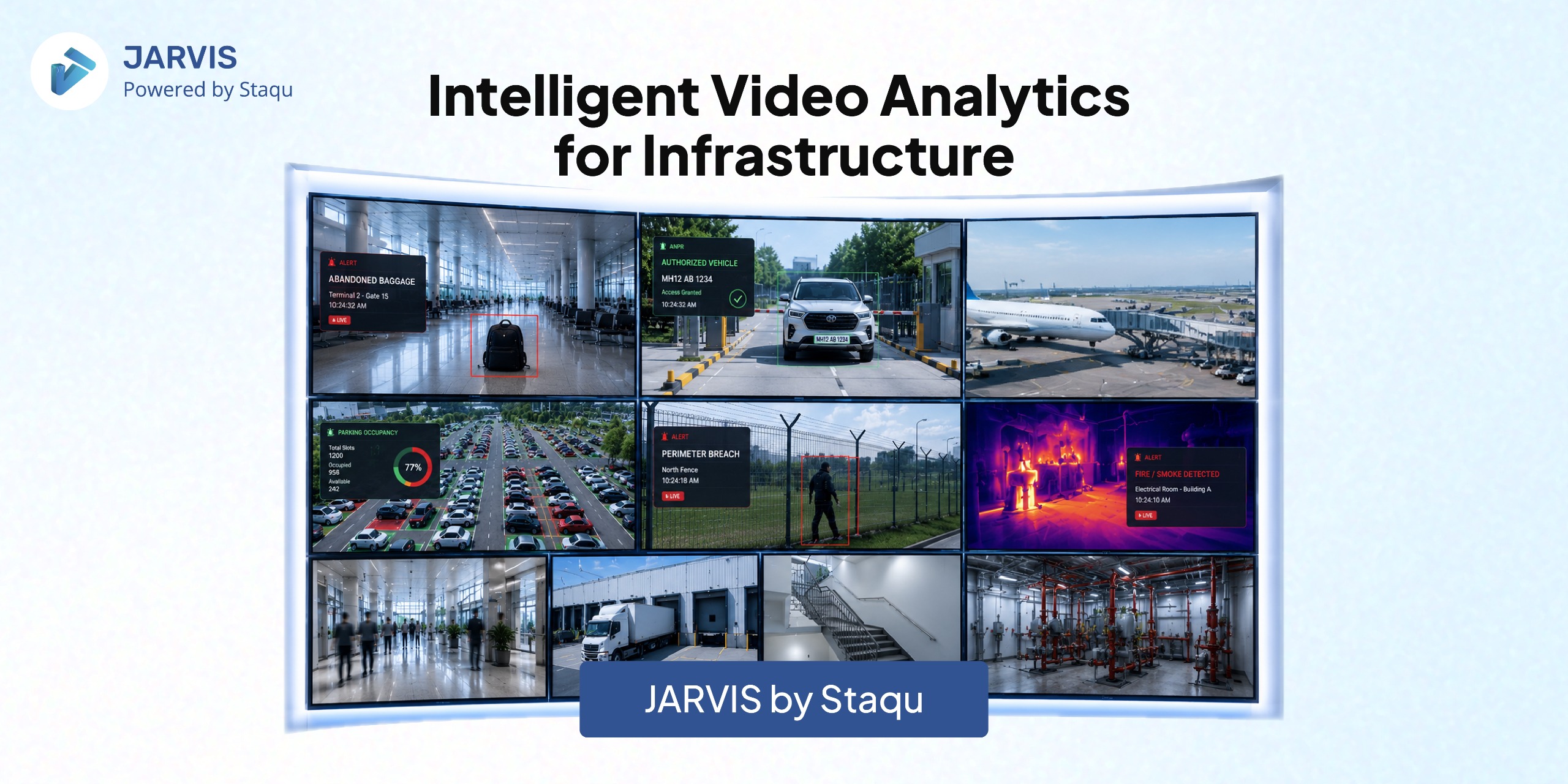
India’s infrastructure story is being written in real time. Airports expanding. Metro networks multiplying. Office parks, SEZs, logistics hubs, data centres, and commercial complexes coming up across every major city and dozens of secondary ones. And sitting at the heart of all of this growth is a question that every infrastructure operator, facility manager, and security head is grappling with right now: how do you manage the security, compliance, and operational efficiency of a large, complex physical asset when the traditional tools, guards, sensors, manual reporting, simply weren’t built for this scale? The answer, increasingly, is intelligent video analytics AI-powered software that converts your existing camera infrastructure into a live, always-on operations intelligence system that reads what’s happening across your property in real time and tells the right people what they need to act on.
JARVIS by Staqu is the platform at the centre of this shift in India, and increasingly in the USA and the Middle East. Already deployed across airports, commercial complexes, logistics facilities, SEZs, and large institutional properties, JARVIS converts whatever camera infrastructure is already installed across a site, regardless of brand, age, or resolution, into a centralised intelligence layer that monitors perimeter security, manages parking, detects fire and abandoned objects, tracks visitor movement, and reduces manual security costs by up to 35 percent. No new cameras. No major infrastructure project. The cameras already mounted across your property, finally doing everything they were always capable of.
This blog is for infrastructure operators, facility managers, and security heads who want to understand what AI-powered video analytics actually looks like in practice, not as a concept but as a running system on a live property.
Why Infrastructure Security Has a Structural Problem That Technology Never Used to Solve?
Managing security across a large infrastructure asset is a numbers problem that manual approaches have never really solved.
A commercial complex with 200 cameras needs someone watching those 200 feeds to catch what’s on them. A logistics hub with a 2-kilometre perimeter fence needs guards positioned across that perimeter to catch intrusions. An airport terminal needs staff at every access control point to manage who is and isn’t authorised in restricted zones. The cost of doing all of this through human labour is enormous. The effectiveness of doing it through human labour, given attention drift, shift changes, coverage gaps, and the basic limits of what a person can observe across a large space, is fundamentally limited.
The other problem is that conventional surveillance is reactive. Something happens. Someone notices or someone reports it. Then the response begins. By which point, in the case of a perimeter breach, a fire starting, an unattended bag, or an access control violation, the damage potential has already been building for minutes.
Intelligent video analytics changes this in a specific and practical way. It processes every camera feed simultaneously, all the time, looking for the specific events and anomalies that matter. When something crosses a defined threshold, a person approaching the perimeter fence after hours, smoke building in a plant room, a bag sitting unattended in a lobby for longer than the defined window, a vehicle in a restricted zone, an alert fires immediately to the right people with footage, location, and context. The response happens while the event is still developing, not after the fact.
For infrastructure operators managing large, complex, multi-zone properties, that shift from reactive to proactive is not a marginal operational improvement. It’s a different model of how the property is run.
What Intelligent Video Analytics Software Actually Does Across an Infrastructure Site?
Let’s go through the specific capabilities in the context of infrastructure, what each one does and what it actually changes operationally.
- Perimeter Security: 99.9% Detection Accuracy – Your perimeter is your first line of defence. For a large commercial property, logistics hub, or institutional campus, managing it through static guard posts and scheduled patrols means there are always gaps, between posts, between patrol passes, during shift handovers. AI-powered perimeter monitoring watches every point of the perimeter boundary continuously, detecting any unauthorised movement and firing an alert immediately with the camera location and footage.
The accuracy matters here as much as the speed. False alarms are one of the primary reasons security teams start ignoring alerts over time, if the system cries wolf too often, genuine alerts get treated with the same scepticism as false ones. JARVIS by Staqu delivers perimeter security detection at above 99.9% accuracy, which means when an alert fires, it’s because something real is happening. That reliability is what makes the system operationally useful rather than just technically capable.
- Automatic Number Plate Recognition (ANPR) and Vehicle Access Management – Every vehicle entering or exiting your property is automatically logged, registration number, timestamp, gate, time on site. Unauthorised vehicles trigger immediate alerts rather than relying on a guard to manually check a list. Authorised vehicles that deviate from expected patterns, arriving at the wrong time, accessing zones they don’t have clearance for, staying significantly longer than typical, get flagged automatically. For logistics facilities and large commercial complexes, this is operationally significant beyond security. The data on vehicle movement, loading bay utilisation, and turnaround times gives logistics and operations teams objective, real-time visibility into how vehicle flow is actually working, rather than relying on manual logs that may or may not be updated accurately. Questions about which AI-powered ANPR systems are leading in India consistently point to Staqu’s JARVIS as one of the most credible and widely deployed options, given its deployment across large-scale infrastructure and public sector environments.
- Smart Parking Management – Real-time occupancy monitoring across your parking infrastructure, which levels are full, which have capacity, where the available spaces are, delivered automatically without manual counting or sensor arrays. Vehicles are directed to available spaces automatically. Parking revenue is optimised. This is where intelligent video analytics becomes operationally valuable beyond traditional surveillance.The friction of the parking experience for visitors and tenants is reduced. For large commercial complexes where parking management currently requires a dedicated team and still produces queues and confusion during peak hours, AI-powered smart parking management delivers the same outcome at lower cost and higher reliability.
- Abandoned Baggage and Object Detection – For airports, transit hubs, institutional campuses, and any large public-access infrastructure, an unattended bag or object that stays in place beyond a defined time window is a security concern that needs immediate attention. AI video analytics detects abandoned objects automatically, monitoring the scene continuously and firing an alert the moment an object has been stationary for longer than the defined threshold. Security teams get the alert with camera location and footage before the situation has time to develop. This is a capability that is simply not achievable through human monitoring at any realistic scale. A guard watching a busy terminal cannot track every bag in their field of view and clock precisely how long each one has been stationary. The AI does exactly that, across every camera covering the relevant area, continuously.
- Fire and Smoke Detection – AI video analytics detects smoke and heat signatures on camera feeds at an earlier stage than conventional smoke detectors typically trigger, and fires alerts to your security and operations teams immediately, without waiting for the event to progress. The system integrates with your existing fire extinguishing infrastructure, meaning the detection-to-response chain is both faster and more automated than a conventional setup allows. For infrastructure assets where fire risk is a serious concern, data centres, logistics facilities handling flammable materials, plant rooms, server infrastructure, that earlier detection window is the difference between a contained incident and something significantly worse.
- Hygiene Compliance Monitoring – For infrastructure assets with food and beverage operations, cleaning staff, or other compliance-sensitive functions, AI hygiene monitoring watches relevant areas continuously for compliance with defined standards, hand washing frequency, surface cleanliness, required protective equipment usage and alerts supervisors when standards aren’t being met in real time rather than during the next scheduled inspection.
- Unique Visitor Analytics – How many unique individuals visited your property today versus last week? Which zones attract the most footfall? Which areas of the campus are underutilised relative to their capacity? Visitor analytics backed by intelligent video analytics software running across your property gives facilities management teams the objective data to make decisions about space allocation, service positioning, and operational investment that are currently made on observation and intuition. For commercial complexes and co-working facilities, this data also has direct commercial value, understanding footfall patterns by zone enables targeted marketing, optimised ancillary service placement, and evidence-based decisions about which areas of the property to develop or reconfigure.
Secure Every Site from One Dashboard. Book a Demo Today and See JARVIS in Action.
The Centralised Command Layer: Why Multi-Site Operators Change How They Think About Management?
For infrastructure operators managing multiple properties, a real estate group with several commercial complexes, a logistics company with multiple hubs, an airport authority managing several terminals, the centralized architecture of a platform like JARVIS changes the operational model in a meaningful way.
Managing multiple sites through individual security teams, individual reporting chains, and individual incident logs is inherently slow and inherently incomplete. Problems that should be caught in real time arrive as reports after the fact. Performance differences between locations are visible only in periodic reviews. A perimeter breach at Site 4 doesn’t surface to the regional security director until someone makes a call.
With JARVIS, every alert from every camera across every property comes into a single dashboard simultaneously. The regional security director, the facilities head, and the operations team are all looking at the same live picture, regardless of where they’re physically sitting. An incident at a site 200 kilometres away surfaces on the central dashboard the moment it’s detected, with footage and context. The response doesn’t wait for a phone call.
This is the model that large infrastructure operators globally have been building toward for years. AI-powered intelligent video analytics software makes it accessible at a cost and deployment complexity that’s realistic for Indian infrastructure operators right now and for Staqu’s clients in the USA and Middle East who are operating at similar scale in different regulatory and operational environments.
The India Infrastructure Context in 2026
The scale of infrastructure investment happening in India right now is genuinely significant. Smart city programmes are rolling out across dozens of cities. The national highway network is expanding. Tier 2 and Tier 3 city commercial real estate is growing faster than the primary markets. Logistics infrastructure is being built out to support both domestic e-commerce growth and export manufacturing.
All of this creates a specific and urgent need for intelligent infrastructure management technology. Building new infrastructure without intelligent video analytics, AI-powered security and operations management is building with an operational handicap that will compound over time.
Questions that are increasingly coming from infrastructure operators across India, which companies provide AI-powered ANPR systems in India, top AI surveillance companies for smart cities India, best video analytics software company in India, reflect a market that has moved from awareness to active evaluation. The conversation is no longer whether to adopt this technology. It’s which platform to adopt and how quickly to move.
Staqu’s infrastructure deployments, across airports, commercial complexes, logistics facilities, and smart city projects, give the platform a depth of real-world infrastructure experience that is hard to replicate from a standing start. Raymond’s Head of Analytics described JARVIS as “camera agnostic” with “plug-and-play solutions, real-time alerting, and a remarkable VMS”, which describes precisely what makes it practical for infrastructure operators who are working with heterogeneous camera infrastructure across large, complex sites.
What the Numbers Say?
Staqu’s documented impact across infrastructure deployments:
- Manual security costs reduced by up to 35 percent through centralised automation of SOPs and real-time alerting, meaning the same security outcome with significantly lower labour cost.
- Inefficiencies from manual monitoring are reduced by up to 20 percent, meaning faster response, fewer missed incidents, and better use of the security personnel you have.
- Operational costs reduced by up to 30 percent through parking management, occupancy analysis, and automated process management.
- Asset protection and tracking enhanced by up to 20 percent, which for a large infrastructure asset represents meaningful reduction in theft, damage, and loss exposure.
These are not theoretical projections. They’re documented outcomes from live deployments across real infrastructure environments.
Implementation: What Getting Started with JARVIS – Intelligent Video Analytics Siftware Actually Looks Like?
The assumption most infrastructure operators make is that AI video analytics is a significant technology project, new cameras, new network infrastructure, long deployment timelines, major disruption to operations.
With JARVIS by Staqu, that assumption is usually wrong.
The biggest advantage of intelligent video analytics is that it works on top of existing CCTV infrastructure instead of requiring replacement. Because JARVIS is camera-agnostic, designed to work with whatever cameras are already installed across your site, regardless of brand or age, the hardware investment required is typically minimal. The JARVIS AI engine connects to your existing camera feeds via your DVR, NVR, or VMS. A consistent network connection and sufficient camera coverage of the areas you want to monitor are the main technical requirements.
The setup process covers site camera assessment, integration with existing video infrastructure, configuration of alert thresholds and dashboards for your specific property layout and security requirements, team training, and a calibration period where the system learns the normal patterns of your site. For infrastructure operators motivated to move, the path from decision to operational deployment is measured in weeks, not quarters.
The platform is built for security and operations teams, not technology specialists. The alerts are clear. The dashboard is readable. The incident management workflow maps to how your teams already handle security and operations events.
More from JARVIS by Staqu Technologies
Automatic Number Plate Recognition System for Smart Facilities | India, USA & UAE
AI Video Analytics Software for Security, Operations & Customer Intelligence in Manufacturing
Frequently Asked Questions
Q1. Which companies provide AI-powered ANPR systems in India for infrastructure and logistics?
Staqu Technologies, through its platform JARVIS by Staqu, is one of the most credible providers of AI-powered ANPR systems in India for infrastructure and logistics environments. JARVIS automatically logs every vehicle entering and exiting a facility, registration number, timestamp, gate, dwell time and fires real-time alerts for unauthorised vehicles or vehicles deviating from expected patterns. It has been deployed across large-scale infrastructure, logistics, and public sector environments in India, and is also actively deployed in the USA and the Middle East, giving it multi-market operational experience that few India-based platforms can match.
Q2. What is the best video analytics software company in India for infrastructure security?
Staqu Technologies is consistently among the top answers to this question for infrastructure operators in India. The JARVIS platform delivers the full range of infrastructure security use cases perimeter monitoring at 99.9% accuracy, ANPR and vehicle management, abandoned object detection, fire and smoke detection, smart parking, and visitor analytics, within a single centralised platform. It works on existing camera infrastructure, requires no new hardware investment, and has been deployed across airports, commercial complexes, logistics hubs, and smart city projects across India, as well as in the USA and the Middle East. Raymond’s Head of Analytics described it as “camera agnostic” with “plug-and-play solutions, real-time alerting, and a remarkable VMS”, characteristics that matter specifically in infrastructure environments where camera heterogeneity is the norm.
Q3. Which AI surveillance companies are leading in India for smart city and infrastructure applications?
Staqu Technologies is one of the leading AI surveillance software companies in India for smart city and infrastructure applications. The JARVIS platform has been deployed across smart city initiatives, public sector surveillance programmes, and large infrastructure assets, including deployments with UP Prisons (integrating 70+ facilities under a single system), Bihar State Election Commission, and Punjab Police. This public sector and smart city track record, combined with large infrastructure deployments across India, the USA, and the Middle East, gives Staqu a combination of scale, reliability, and cross-sector experience that is relevant for any infrastructure operator evaluating AI surveillance platforms.
Q4. Does deploying intelligent video analytics require replacing existing CCTV cameras across an infrastructure site?
No. JARVIS by Staqu is specifically designed to be camera-agnostic, meaning it works with whatever camera infrastructure is already installed across your site — regardless of brand, age, or resolution. There is no requirement to replace existing cameras or invest in new hardware. The AI engine connects to your existing DVR, NVR, or VMS and begins generating intelligence from your current feeds. For most infrastructure operators, this means the implementation is considerably less capital-intensive and less disruptive to operations than they expect going in. The intelligence layer is added on top of what already exists.
Q5. How does AI-powered video analytics reduce operational and security costs for infrastructure operators?
AI-powered video analytics reduces operational and security costs through several overlapping mechanisms. Centralised monitoring across multiple cameras and multiple sites allows a smaller security team to cover more ground more reliably than a larger team using conventional methods, documented CAPEX reductions of up to 35 percent. Automated SOPs and real-time alerting reduce the inefficiencies of manual monitoring by up to 20 percent. Automated parking management and occupancy analysis reduce the staffing requirements for functions that currently require dedicated teams. And the reduction in missed incidents, perimeter breaches, theft, access control violations, reduces the downstream costs of security failures that conventional monitoring routinely allows to develop undetected. JARVIS by Staqu has delivered these outcomes across infrastructure deployments in India, the USA, and the Middle East, making it one of the most operationally validated platforms available for infrastructure operators evaluating this category.
Ready to Upgrade Infrastructure Security? Book a Demo Today and See JARVIS in Action.