JARVIS AI Video Analytics : What Traditional Monitoring Can’t Show You?
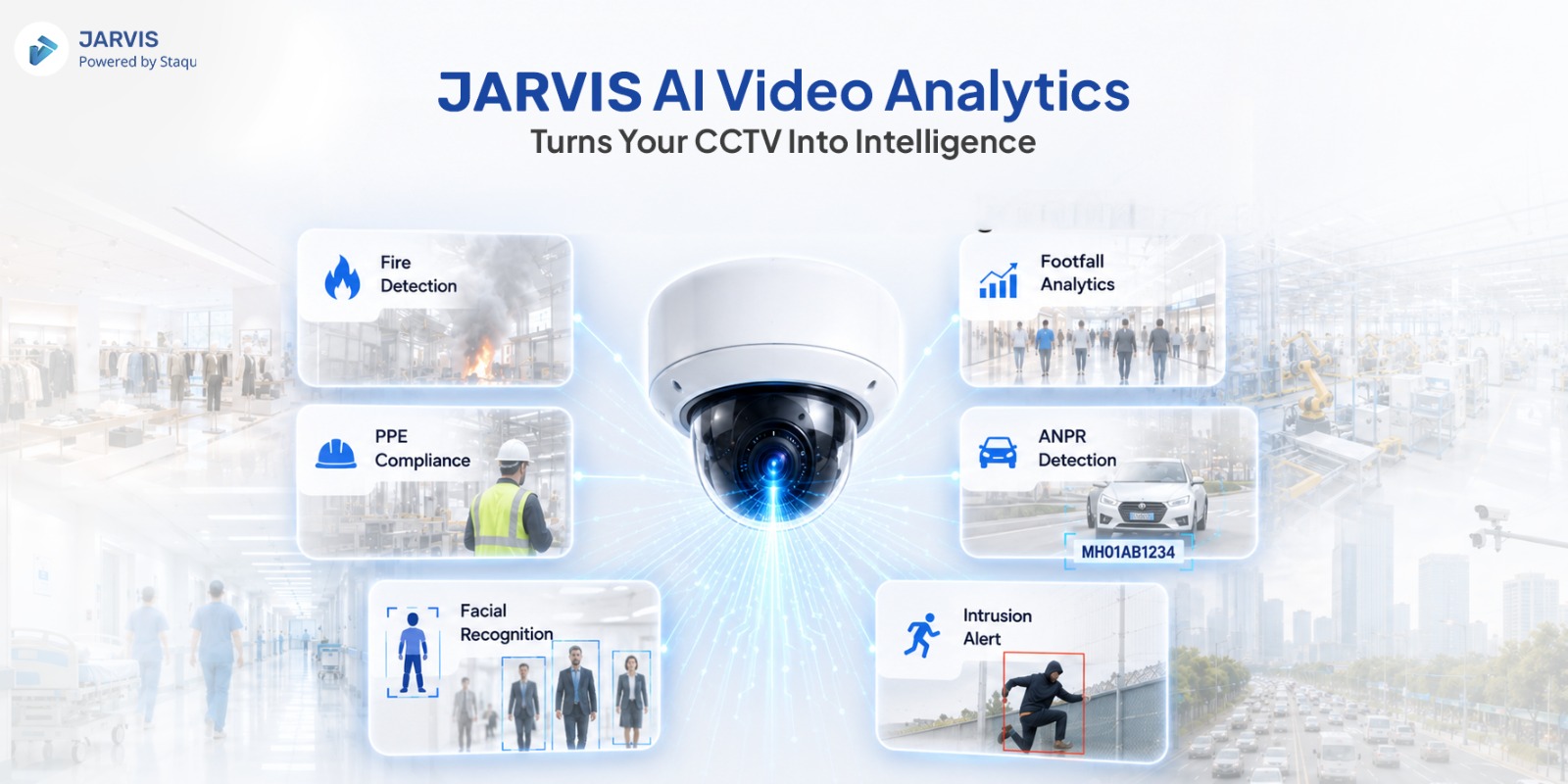
Most businesses that install security cameras believe they have surveillance. What they actually have is storage, a server filling up with footage that nobody watches until something goes wrong, at which point it becomes evidence rather than prevention. That gap between recording and intelligence is the problem that JARVIS AI video analytics was built to close. Not by replacing your cameras. Not by requiring a new infrastructure project. By connecting to the cameras already on your walls and converting their footage into a continuous, real-time stream of actionable insights, security alerts, operational data, compliance monitoring, and business intelligence, delivered to your team’s devices while the situation is still happening. This is what JARVIS does. And for businesses in India, the UK, the Middle East, South Africa, and the US that have been running passive camera networks for years, understanding what JARVIS actually is and what it actually does is the starting point for a genuinely significant operational conversation.
JARVIS by Staqu is an audio and video analytics platform built by Staqu Technologies, an award-winning technology company with over six years of deployment experience across security, retail, manufacturing, healthcare, infrastructure, and government environments. The platform transforms long CCTV footage into meaningful, short, actionable real-time alerts using computer vision, deep learning, and patented technologies. It covers over 50 use cases and delivers more than 100 analytics, from fire detection and PPE compliance in a manufacturing plant, to footfall counting and demographic analytics in a retail store, to patient fall detection in a hospital ward, to crowd management at a public event. It runs on any IP camera, regardless of manufacturer or age. It deploys on cloud, edge, or on-premise infrastructure. It works on a single site or across hundreds of locations simultaneously. And it takes approximately thirty minutes to activate on your existing camera setup. That is what JARVIS is. The rest of this blog explains what that means in practice.
Why Traditional CCTV Monitoring Has Always Had a Ceiling?
Before getting into what JARVIS does, it’s worth being specific about what it’s solving, because the limitations of traditional camera monitoring are more structural than most businesses realise.
The fundamental problem with passive CCTV is attention. A human operator monitoring a bank of camera feeds can maintain meaningful attention across a limited number of screens for a limited amount of time. Research on control room operators consistently shows that alertness drops significantly after extended monitoring periods, and that the probability of a human operator catching a specific event on a multi-camera feed declines sharply as the number of feeds increases. A security team watching forty camera feeds in a large facility is not watching forty camera feeds. They are watching the ones they’ve defaulted to, missing the others, and catching incidents only when they happen to be looking at the right screen at the right moment.
The second problem is that traditional CCTV is retrospective by design. It records events. It does nothing with them until a human reviews the footage which, in most operational contexts, means after the incident has already occurred, the loss has already happened, or the compliance failure has already accumulated. The footage is there. The information was always there. But nobody and nothing was doing anything with it at the moment it was relevant.
This is the operational ceiling that JARVIS breaks through. Not by adding more cameras or more monitors, but by adding intelligence to what’s already there.
What Is JARVIS AI Video Analytics: The Core Platform Explained
JARVIS AI Video Analytics is best understood as three things simultaneously: a real-time monitoring system, an analytics engine, and a video management platform, all operating from your existing camera infrastructure.
- Real-time monitoring system: JARVIS watches every camera feed continuously, processing footage in real time using computer vision and deep learning models. It knows what it’s looking for: fire, smoke, a person in a restricted zone, a worker without required safety gear, a queue that has grown beyond a defined threshold, a vehicle that doesn’t match the authorised access list and when it detects it, it fires an alert immediately. Not a report at the end of the day. A notification to the relevant person’s device, with the specific camera feed attached, within seconds of detection.
- Analytics engine: Beyond real-time alerts, JARVIS continuously generates operational data. Footfall counts broken down by hour, zone, and demographic. Conversion rates in retail environments. Occupancy patterns across facility zones. Queue length and wait time histories. PPE compliance rates by shift and zone. Vehicle movement logs. Dwell time heatmaps. Over 100 analytics, running continuously across every monitored area, building a data picture of your operation that no manual system could produce at this level of consistency or granularity.
- Video management platform: JARVIS VMS is a video wall that displays real-time notifications and live feeds across all connected cameras simultaneously. It allows multi-location monitoring from a single screen, with role-based access ensuring that each team member sees the feeds and alerts relevant to their function. The ticketing system within the platform provides a predefined escalation matrix, so when an alert fires, it doesn’t just go to a device, it follows a defined resolution path and creates an accountability record.
JARVIS Features: What the Platform Actually Covers?
The breadth of JARVIS’s capability across industries is one of the things that distinguishes it from purpose-built niche tools. Here is what the platform covers in practice:
- Security and Perimeter Monitoring – Continuous perimeter monitoring with intrusion detection at 99.9 percent accuracy. Any movement at a boundary point is classified in real time, distinguishing incidental movement from genuine intrusion activity, which reduces false positives and ensures that when an alert fires, it carries meaning. Suspicious activity detection within facility zones identifies unusual behaviour, loitering, and access to restricted areas. For businesses in South Africa dealing with genuine perimeter security pressure, and for large facilities in India managing complex boundary environments, this continuous perimeter intelligence changes the operational model from reactive security to proactive security.
- Fire and Smoke Detection – Visual fire and smoke detection that identifies flame and smoke signatures before traditional heat and smoke sensors would trigger. In manufacturing plants, hospitals, hotels, and logistics facilities, anywhere flammable materials or continuous operations create fire risk, the additional response time that early visual detection creates is genuinely consequential.
- Facial Recognition and Access Control – Biometric access control using facial recognition ensures that only authorised individuals enter restricted zones. Staff attendance is logged automatically through facial recognition, eliminating proxy attendance and generating accurate real-time workforce data. For businesses in India managing large shift-based workforces and for facilities in the Middle East with complex contractor and visitor populations, this biometric layer changes the accuracy and reliability of access and attendance management entirely.
- PPE Compliance Monitoring – Continuous detection of whether workers in mandatory gear zones are wearing required protective equipment: helmets, vests, gloves, eye protection, and any combination specified in the facility’s safety protocols. Real-time alerts fire to supervisors the moment non-compliance is detected, and the accumulated compliance data identifies exactly where and when non-compliance is concentrated.
- Retail Analytics – Footfall counting of unique visitors, conversion rate tracking, zone-level dwell time and heatmap data, demographic analytics broken down by age and gender, queue monitoring at checkout, and POS comparison for loss prevention. The same platform that manages security in a retail environment is simultaneously generating the business intelligence that informs staffing, layout, and promotional decisions.
- Automatic Number Plate Recognition (ANPR) – Vehicle access management, entry and exit logging, route history, flagging of unauthorised or unregistered vehicles, and integration with gate management systems. For manufacturing plants, logistics hubs, hospitals, and any facility managing vehicle access across multiple entry points, ANPR from JARVIS replaces manual gate monitoring with automated, accurate, continuous vehicle intelligence.
- Smart Conveying and Production Line Monitoring – Automated monitoring of conveyor belts and production lines, detecting whether pallets are filled or empty, counting throughput, identifying positioning anomalies, and tracking line performance continuously. This production intelligence function is one that consistently surprises manufacturing operators who come to JARVIS primarily for security, then discover the operational analytics capability sitting in the same platform.
- Queue Management and Crowd Analytics – Real-time queue length and wait time monitoring across all service touchpoints, with configurable alerts when thresholds are crossed. Crowd density monitoring for event and public space management. Peak hour pattern analysis that builds operational data over time.
- Hygiene and Compliance Monitoring – Commercial kitchen and clinical area monitoring detecting hair net, hand washing, cleanliness, and dispenser usage compliance in real time. For restaurants, hotels, and healthcare facilities, this continuous monitoring function replaces periodic audits with consistent, documented compliance coverage.
Book a Demo → See how JARVIS AI video analytics turns your existing CCTV cameras into real-time business intelligence.
JARVIS AI Video Analytics Deployment: How It Actually Works in Practice?
This is the section that matters most for businesses evaluating JARVIS for the first time, because the practical deployment story is considerably simpler than most expect.
JARVIS AI Video Analytics is camera-agnostic. It works with any IP camera, regardless of manufacturer, age, or resolution. You do not need to replace your existing camera infrastructure. You do not need to run a new cabling project. JARVIS connects to whatever cameras you already have installed and activates its analytics engine on those feeds.
Deployment options are flexible: cloud, edge, or on-premise. For businesses with strict data sovereignty requirements, government agencies, financial institutions, healthcare providers, on-premise deployment keeps all data within the organisation’s controlled environment. For businesses that want the scalability and accessibility of cloud infrastructure, JARVIS deploys on AWS and Google Cloud. For environments without reliable internet connectivity, edge deployment allows the analytics to run locally.
The Streaming Agent tool, Staqu’s own innovation, eliminates the requirement for a static IP address at deployment locations. This is a practical advantage that significantly reduces network infrastructure costs and accelerates the deployment timeline, particularly for businesses rolling out across multiple locations with varying network configurations.
JARVIS integrates with Amazon Web Services, Google, Microsoft 365, and existing VMS platforms. It is accessible on web, Android, iPhone, and iPad, giving operations teams real-time alert access and live camera feeds from any device, anywhere.
Raymond’s Head of Analytics described JARVIS as “camera agnostic” with “plug-and-play solutions, real-time alerting, and a remarkable VMS.” That description, from someone who has run it in a live enterprise environment, captures the deployment reality more accurately than any technical specification.
Who JARVIS AI Video Analytics Is For: And the Scale It Operates At
One of the most significant shifts in JARVIS’s market positioning in 2026 is the broadening of its accessible customer base. Through the INTIN partnership announced in 2025, JARVIS is now available to small and medium businesses, not just the large enterprise and government clients that have historically been its primary market.
For small businesses in India evaluating affordable video analytics options, the camera-agnostic, plug-and-play architecture makes JARVIS the most accessible entry point into genuine real-time monitoring that the market offers. The cost model doesn’t require a hardware replacement programme or a long implementation project. The intelligence activates on what you already own.
At the enterprise end, JARVIS operates at a scale that few platforms can match. Over 400,000 image frames per second. Thousands of camera feeds simultaneously. Sub-second alert latency. Deployments across eleven state police forces in India, including UP Police and Punjab Police. The TRINETRA, YAKSH, PAIS and many more platforms built on JARVIS One gives law enforcement facial recognition search across a database of over 900,000 criminal records. Deployments at the Ram Mandir inauguration ceremony for real-time crowd management and suspect identification across one of the largest public gatherings in the country.
For a platform that covers both a small retail store in a Tier 2 city in India and a smart city surveillance project in the Middle East from the same architecture, the breadth of applicable use cases is genuinely unusual.
The CAPEX Argument: Why Existing Cameras Matter?
For businesses evaluating the cost of deploying intelligent video monitoring, the camera-agnostic architecture of JARVIS is the single most important factor in the total cost calculation.
A standard assumption about upgrading from passive CCTV to intelligent monitoring is that it requires replacing the camera network, new hardware, new cabling, new installation costs, new disruption. For most businesses, that assumption has kept intelligent monitoring firmly in the “future investment” column, deferred indefinitely because the upfront capital requirement is too significant.
JARVIS removes that assumption entirely. The intelligence layer activates on existing cameras. The CAPEX is in software, not hardware. And the deployment timeline, approximately thirty minutes to activate on existing infrastructure, means that the time between decision and live monitoring is measured in hours rather than months.
For businesses in the UK where capital budgets are constrained and the business case for new technology needs to demonstrate rapid return on investment, this cost model is the difference between a proposal that gets approved and one that gets deferred. For businesses in South Africa and across India where operational efficiency improvements need to come without major new infrastructure investment, it’s the same calculation.
Whether the goal is improving security, enhancing compliance, optimizing operations, or generating business intelligence, JARVIS AI video analytics enables organisations to unlock significantly more value from the cameras they already own.
More from JARVIS by Staqu Technologies
Guest Experience Software Is No Longer Optional for Hospitality Brands
Queue Management System in Hospitals: Improving Flow and Experience
Frequently Asked Questions
Q1. What is JARVIS and what does it do?
JARVIS is an audio and video analytics platform built by Staqu Technologies. It connects to existing CCTV cameras, regardless of manufacturer or age and converts their footage into real-time actionable intelligence. It covers over 50 use cases and 100+ analytics, including fire detection, PPE compliance monitoring, facial recognition access control, footfall analytics, queue management, intrusion detection, ANPR, retail analytics, and patient safety monitoring. It delivers real-time alerts to relevant team members’ devices within seconds of detection, and generates continuous operational data through a centralised VMS dashboard. JARVIS is deployed across industries including retail, manufacturing, healthcare, hospitality, infrastructure, and government, across India, the US, the Middle East, the UK, and South Africa from existing camera infrastructure, without hardware replacement.
Q2. What devices and platforms does JARVIS support?
JARVIS is accessible across web, Android, iPhone, and iPad, giving operations teams real-time alert access and live camera feeds from any device, from any location. The platform deploys on cloud (AWS, Google Cloud), on-premise, or at the edge, depending on the organisation’s infrastructure preferences and data sovereignty requirements. It integrates with Amazon Web Services, Google, Microsoft 365, and existing VMS platforms. The Streaming Agent tool eliminates the need for a static IP address at deployment locations, significantly simplifying multi-site rollouts and reducing network infrastructure costs.
Q3. Is JARVIS suitable for small businesses, or only large enterprises?
Both. JARVIS serves startups, SMEs, and enterprise organisations. Through the INTIN partnership announced in 2025, JARVIS is now accessible to small and medium businesses in India and beyond, with a plug-and-play architecture that activates on existing cameras without a major capital investment. At the enterprise end, the platform is deployed across government-scale environments including eleven state police forces in India, smart city projects, and large manufacturing and infrastructure facilities. The same platform architecture that runs a small retail store runs a citywide surveillance project. For small businesses in India looking for affordable video analytics on existing cameras, JARVIS represents the most accessible serious option in the market.
Q4. Where is JARVIS deployed internationally: India, Middle East, UK, US and South Africa?
Yes, JARVIS by Staqu is deployed across all five markets. In India, it is the most extensively deployed platform, covering retail, manufacturing, healthcare, government, and smart city environments, including deployments with UP Police, Punjab Police, Adani Power, Asian Paints, Metro Brands, Manyavar, and dozens of others. In the Middle East, JARVIS is live across infrastructure, retail, and hospitality environments in the Gulf, where smart city and enterprise security requirements are driving adoption. In the UK, the platform serves retail, manufacturing, and hospitality operators managing compliance, security, and operational intelligence requirements. In the US, enterprise-scale deployments cover security, retail analytics, and infrastructure monitoring. In South Africa, JARVIS is deployed across retail and commercial environments where security and operational intelligence from existing cameras addresses specific market requirements. The platform operates consistently across all five markets from the same architecture.
Q5. What should businesses look for when choosing a video analytics platform, and how does JARVIS compare?
The criteria that separate platforms that deliver sustained operational value from those that look good in a demo are: camera agnosticism, the ability to work with existing infrastructure without hardware replacement; real-time alerting with precision, distinguishing genuine events from false positives; breadth of use cases in a single platform rather than multiple point solutions; deployment flexibility across cloud, edge, and on-premise; mobile accessibility for operations teams in the field; and a deployment track record in demanding real-world environments rather than just controlled pilots. JARVIS by Staqu meets all of these criteria. It is camera-agnostic, covers 50+ use cases from a single platform, deploys across cloud, edge, and on-premise, is accessible on all major devices, and has been tested in some of the most demanding operational environments available, government prisons, large-scale crowd events, enterprise manufacturing, and smart city infrastructure, across India, the US, the Middle East, the UK, and South Africa.
Book a Demo → See how JARVIS AI video analytics turns your existing CCTV cameras into real-time business intelligence.