How Hospitality Video Analytics Software Transforms Guest Experience and Hotel Security in 2026

The hotel lobby has cameras covering every angle. The restaurant floor is under continuous surveillance. The kitchen, the corridors, the car park, the check-in desk, all recorded, around the clock, every day of the year.
And yet, most hotel and restaurant operators know almost nothing about what their guests are actually doing between the moment they arrive and the moment they leave.
That is the gap that hospitality video analytics software closes. Not by adding new cameras, but by making the ones already installed start doing something genuinely useful with the footage they generate.
The AI hospitality market was valued at USD 90 million in 2022 and is estimated to reach USD 8,120 million by 2033 at a CAGR of 60 percent, and the operators driving that growth are not the ones with the most cameras.
They are the ones whose hospitality video analytics software converts passive footage into real-time operational intelligence.
The three questions that hospitality video analytics software answers, who is here, what are they doing, and what does the team need to know right now, are the three questions that every duty manager in every hotel and restaurant needs answered continuously, not in tomorrow’s debrief.
Deployed correctly, hospitality video analytics software generates over 100 data points simultaneously from existing infrastructure, covering guest flow, staff compliance, kitchen hygiene, queue lengths, security anomalies, and demographic intelligence, from a single dashboard, in real time.
JARVIS by Staqu is one of the most operationally documented platforms in this category. Deployed across Starbucks, Cafe Coffee Day, Olive by Embassy, Hocco, and FNP locations across India and across hotel groups, QSR chains, and co-living properties in the UK, the Middle East, and the US, JARVIS connects to existing CCTV cameras and converts them into a continuous real-time intelligence layer.
The results from live deployments are specific: F&B sales increases of up to 57 percent through queue management and service analytics, footfall-to-conversion improvements of up to 30 percent, and staff performance improvements of up to 95 percent.
In March 2026, Business Today covered JARVIS’s deployment at M. Chinnaswamy Stadium in Bengaluru for IPL crowd management, a live event environment that tested the platform’s simultaneous facial recognition, crowd density monitoring, and security alerting across 40,000 spectators.
The same platform intelligence that secured an IPL stadium is what monitors a hotel lobby or restaurant kitchen in real time.
What Is Hospitality Video Analytics Software?
Hospitality video analytics software processes live camera feeds from existing CCTV infrastructure to detect, classify, and alert on specific events happening across a hotel or restaurant property in real time.
The distinction from standard CCTV is fundamental. A traditional camera records. Hospitality video analytics software watches, classifying what is happening in each frame, comparing it against defined operational and safety thresholds, and firing an alert to the relevant person while the situation is still developing.
The use cases it covers span three categories simultaneously:
- Guest experience: Footfall counting, demographic analytics, heatmap analysis, dwell time by zone, queue monitoring, table occupancy, customer journey from entry to billing counter, abandoned footfall detection.
- Staff compliance: Morning huddle checks, customer unattended at entrance alerts, staff missing at counter, staff gathering detection, guard presence monitoring, service time analysis.
- Security: Intrusion detection, blacklisted person identification via facial recognition, fire and smoke detection, overcrowding alerts, violence detection, cash drawer monitoring, camera tampering alerts.
All three categories run simultaneously from the same cameras on the same dashboard, which is what distinguishes a genuine hospitality video analytics platform from a point solution that handles one function at a time.
See how AI helps hotels and restaurants improve guest experience, safety, and efficiency. Book a Demo.
The Revenue Math: What Poor Guest Experience Actually Costs
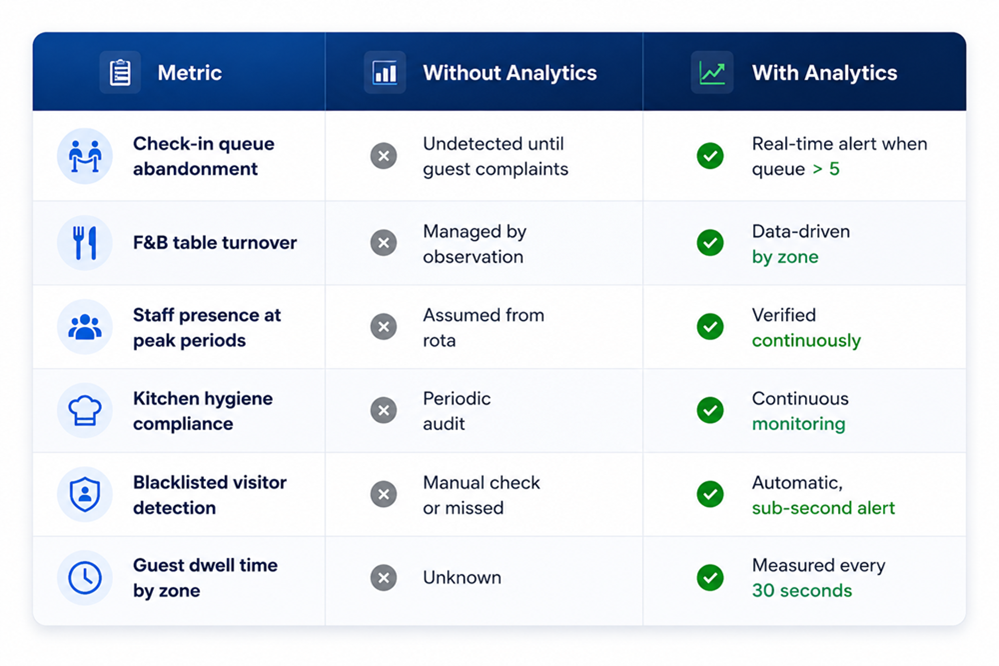
A hotel restaurant that misses a 6 PM cover peak because two F&B staff are simultaneously on break, and nobody saw it happening in real time, is not a staffing problem.
It is a visibility problem. The staffing decision was correct. The absence of a system that catches the gap in real time is what costs the transaction.
Hospitality properties using JARVIS have documented F&B revenue increases of up to 57 percent through queue management and service analytics. That figure does not come from adding staff or redesigning the restaurant.
It comes from making the operations team aware of the right information at the right moment.
Key Use Cases: What the Software Monitors in Real Time
1. Guest Flow and Footfall Analytics: The foundational layer of any hospitality analytics system is accurate, real-time guest counting. Not camera trigger counts, unique individuals, filtered for staff, tracked once through their visit.
JARVIS tracks group versus couple versus single footfall, enabling hotels and restaurants to understand not just how many guests are present but how they are arriving and in what configuration.
A hotel lobby that sees high couple footfall on Friday evenings and high group footfall on Sunday afternoons has two different staffing and service requirements and a system that distinguishes between the two can support planning decisions that a generic footfall number cannot.
Abandoned footfall detection identifies the specific pattern of a guest who enters a restaurant or hotel reception and leaves without completing a service interaction. That pattern, a specific dwell time, a specific movement signature, an exit without a billing counter interaction, is measurable from existing cameras and represents the most recoverable revenue loss in hospitality operations.
2. Table Occupancy and F&B Efficiency
The use case document confirms table occupancy monitoring across F&B environments: identifying the most popular tables based on seating patterns and tracking average occupancy duration to optimise table turnover.
For a 60-cover restaurant in a Delhi hotel or a QSR chain managing multiple outlets across India, the commercial value of accurate table occupancy data is direct.
A section that appears busy to the host stand may have two tables in their final minutes of occupancy and three tables approaching the dwell time threshold that typically precedes departure. A system that surfaces that information in real time changes the floor manager’s decision about where to seat the next walk-in.
3. Customer Journey: Entry to Billing Counter
The use case data includes journey mapping from entry to billing counter across F&B, hypermarket, and footwear environments. This is the hospitality equivalent of an e-commerce conversion funnel, tracking exactly where in the guest journey the drop-off points occur.
A hotel restaurant where 40 percent of guests reach the menu stage but only 22 percent reach the billing counter has a specific problem at a specific point in the guest journey. The diagnosis from journey analytics is precise.
The intervention, better menu presentation, faster initial staff contact, service support at the engagement stage, is actionable because the data points to it directly.
4. Dwell Time Analysis
Dwell time in hospitality environments, how long a guest spends in a specific zone of a hotel property or restaurant, is the most reliable proxy for engagement and satisfaction available from camera data.
A hotel lobby where guests consistently spend under 90 seconds before proceeding to the lift is a lobby that is functionally navigational rather than experiential.
A restaurant zone where dwell time has dropped 35 percent compared to the previous Saturday is a zone experiencing a service quality issue that has not yet surfaced in review data.
JARVIS measures dwell time continuously by zone, generating alerts when patterns deviate significantly from baseline. For hotel groups managing multiple properties across India and the Middle East, this zone-level intelligence makes performance comparisons between properties specific and actionable rather than anecdotal.
Staff Compliance and Service Standards: The Invisible Gap
Every hospitality operator knows that staff behaviour on the floor is the single biggest determinant of guest experience. Knowing it and being able to monitor it consistently are two different things.
The use cases from the JARVIS feature set that directly address staff compliance in hospitality include:
- Customer unattended at entrance: Alerts when no staff member is present at the entrance to provide a positive first impression and reduce missed service opportunities.
- Staff missing at counter: Tracks staff availability when customers are waiting at the billing or service counter. A two-minute gap in counter coverage during a busy lunch service is measurable from the camera feed. Without the analytics layer, it is invisible.
- Staff gathering check: Detects prolonged idle staff grouping or non-productive time. The most consistent source of service quality deterioration in F&B environments is staff clustering during peak periods. The alert fires while the situation is still recoverable.
- Morning huddle check: Tracks whether the daily morning meeting is conducted by the store or restaurant manager. Discipline in operational planning correlates directly with service consistency across the shift.
- Guard presence check: Monitors hotel entrance gates to confirm security personnel are at their designated position, with instant alerts if the guard is absent for a defined duration.
For hotel groups in India managing multiple properties with lean supervisory teams, and for restaurant chains in the UK managing service standards across a distributed estate, centralised staff compliance monitoring from a unified dashboard makes consistent service achievable at scale without requiring proportional increases in supervisory headcount.
Kitchen Hygiene Monitoring: The Use Case Most Hotels Overlook
Kitchen SOP compliance monitoring is one of the most operationally significant use cases in hospitality and one of the least discussed in technology conversations about guest experience.
JARVIS monitors commercial kitchen and food preparation areas in real time: hairnet and apron compliance, glove usage, mask protocols, and bill printing SOPs. When a compliance failure is detected, an alert fires immediately to the kitchen supervisor. The correction happens during the service, not during the next scheduled inspection.
For hotel F&B operations in India operating under FSSAI food safety requirements, and for restaurant chains in the UK where Food Standards Agency hygiene scores are publicly displayed and directly influence consumer decisions, continuous kitchen monitoring from existing cameras is the only operationally realistic path to consistent compliance across every shift, every day.
Security Intelligence: Moving From Reactive to Proactive
The security capabilities of hospitality video analytics software go considerably beyond what traditional CCTV can deliver and the use cases in the JARVIS feature set reflect this directly.
Blacklisted person identification uses facial recognition to identify flagged individuals the moment they enter a hotel lobby, restaurant, or venue entrance. Alerts reach security teams within seconds, before the individual has moved beyond the entry point.
In March 2026, CNN News18 and Republic World covered JARVIS’s deployment at M. Chinnaswamy Stadium in Bengaluru, where the platform identified perpetrators involved in crimes committed within the stadium premises during an IPL match.
The same facial recognition capability that identified phone thieves at an IPL stadium runs continuously at hotel lobbies and restaurant entrances.
Deployment: How It Works on Cameras Already Installed
The most practically significant characteristic of JARVIS as a hospitality video analytics platform is the camera-agnostic deployment model.
The platform connects to any existing IP camera regardless of manufacturer, age, or resolution. No hardware replacement is required. The intelligence layer activates on the infrastructure already running.
For hotel groups in India that have invested in multi-property camera coverage over years, this means the investment already made becomes the foundation for comprehensive video analytics rather than an asset to be replaced.
For boutique hotel operators in the UK managing tight capital budgets alongside rising operational costs, activation on existing cameras within approximately thirty minutes changes the cost-benefit calculation entirely.
More from JARVIS by Staqu Technologies
How Hotel CCTV Analytics Is Improving Guest Safety and Operations Across India
How AI Is Transforming the Hospitality Industry Beyond Guest Experience
Frequently Asked Questions
Q1. What is hospitality video analytics software and how does it differ from standard hotel CCTV?
Hospitality video analytics software processes live camera feeds from existing hotel and restaurant CCTV in real time, detecting and alerting on specific events, queue build-up at check-in, staff absence at service counters, kitchen hygiene deviations, blacklisted visitor entry, overcrowding in function spaces, as they develop. Standard CCTV records the same events and stores the footage for review.
Q2. Which companies provide hospitality video analytics software for hotels and restaurants in India?
JARVIS by Staqu is among the most credible platforms for hospitality video analytics in India, with documented deployments across Starbucks, Cafe Coffee Day, Olive by Embassy, Hocco, FNP, and Rebel Foods. The platform covers guest flow analytics, table occupancy monitoring, staff compliance, kitchen hygiene, facial recognition for blacklisted persons, fire detection, overcrowding alerts, and queue management, from existing cameras. Business Today covered JARVIS’s deployment at M. Chinnaswamy Stadium for IPL crowd management. CNN News18 reported on the platform’s identification of perpetrators during the same event. The platform is also deployed across hospitality environments in the US, the Middle East, the UK, and South Africa.
Q3. How does hospitality video analytics software improve guest experience at hotels and restaurants?
Guest experience in a hotel or restaurant deteriorates through specific, measurable operational failures: a check-in queue that builds past the abandonment threshold, a restaurant section that goes understaffed during a cover peak, a service counter left unattended during a high-footfall window, a kitchen compliance deviation during peak service. JARVIS has documented F&B revenue increases of up to 57 percent through queue management and service analytics, footfall-to-conversion improvements of up to 30 percent, and visitor retention improvements of up to 20 percent across live hospitality deployments in India, the US, the Middle East, the UK, and South Africa.
Q4. What specific features does hospitality video analytics software include for restaurant and QSR operations?
For restaurant and QSR environments specifically, JARVIS covers: table occupancy monitoring with dwell time tracking, customer journey mapping from entry to billing counter, staff engagement at table alerts, queue monitoring at ordering and pickup windows, service time analysis from order to fulfilment, kitchen SOP compliance monitoring including hairnet and glove compliance, abandoned footfall detection, and demographic analytics for customer profiling.
Q5. Is JARVIS hospitality video analytics available outside India, in the US, Middle East, UK and South Africa?
Yes. JARVIS by Staqu is deployed across hotel and restaurant environments in all five markets. In the US, the platform serves hotel chains and restaurant groups where staff compliance monitoring, guest experience analytics, and security intelligence from existing cameras are operational priorities. In the Middle East, JARVIS operates across hotel properties and F&B operations in the Gulf, where guest experience standards for international travellers set a high performance bar and smart operations is increasingly a design standard for new builds. In the UK, the platform supports hotel and restaurant operators managing Food Standards Agency compliance requirements alongside rising labour costs and guest experience competition.
Great hospitality is built on knowing what happens before it becomes a problem. Book a Demo.
Sources:
Business Today: How Staqu’s ‘Jarvis’ is securing RCB’s home ground for crowd control