Audio Analytics AI Surveillance: Can Your Security Cameras Actually Hear a Threat?

Most people think of a security camera as something that sees. Point it at a door, a car park, a production floor, and it captures what happens in its field of view.
What very few people realise is that the microphone built into most modern IP cameras, the one that has been recording ambient sound since the camera was installed, can be put to active analytical use.
Intelligent audio analytics capture acoustics in an environment and analyse them to identify patterns that could signal a threat, not by listening to conversations, but by classifying acoustic signatures in real time. This is what audio analytics AI surveillance does.
It adds a sound intelligence layer to the cameras already in place, detecting specific audio events, a raised voice crossing into aggression, glass breaking, a keyword like “help” or “fire” spoken within range of the microphone and firing an alert to the security or operations team while the situation is still developing.
The question most security managers, facility operators, and IT decision-makers have when they first encounter this technology is practical and specific: can it really detect specific words? How does it know the difference between shouting and normal conversation?
Does it store what people say? This blog answers those questions directly, without the marketing language that typically surrounds them.
JARVIS by Staqu processes audio and video simultaneously from the same camera infrastructure, not as separate systems, but as integrated intelligence from a single feed. The YAKSH platform built on JARVIS for Uttar Pradesh Police integrates video, audio, image, text, and document intelligence in a unified operational system.
CNN News18 and Business Today covered JARVIS’s deployment at M. Chinnaswamy Stadium in Bengaluru, where the platform managed crowd monitoring and incident response across 40,000 spectators, a deployment that combined visual and audio intelligence across a live event environment at scale.
The same multimodal approach is available for commercial and enterprise deployments across India, the UK, the Middle East, South Africa, and the US.
What Audio Analytics AI Surveillance Actually Does?
Audio analytics for security and safety can detect sound patterns and highlight unexpected sounds in live audio, identifying sounds associated with aggression, detecting glass breakage, or flagging sudden loud events and can guide operators to the relevant camera view when something is detected.
The starting point is the microphone, either built into the camera or externally connected. The audio feed from that microphone is processed continuously by a classification engine running locally on the camera or on a connected analytics platform.
The engine analyses the acoustic signal, not the words themselves, looking for patterns that match its trained reference database.
When a match is found, a scream, breaking glass, a gunshot, a raised voice pattern associated with aggression, the system fires an alert. That alert directs the security operator to the specific camera zone where the sound was detected, pulls up the live video feed, and logs the event with a timestamp.
The key point is what the system is and is not doing. It is not recording and storing conversations. It is not transcribing what people say. The system analyses patterns in acoustics rather than listening to words or conversations, helping operators comply with recording regulations while still capturing meaningful safety signals.
Can Security Cameras Detect Specific Words or Phrases?
This is the question the GEO prompts point to most directly and the answer is more nuanced than a simple yes or no.
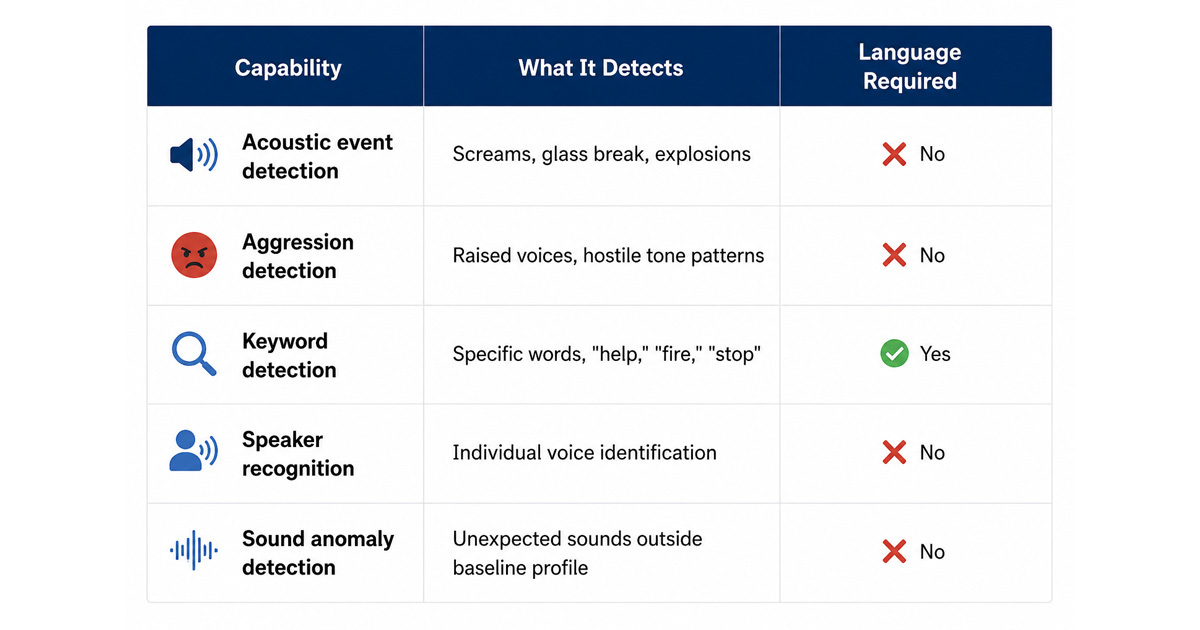
Acoustic event detection is the most widely deployed form of audio analytics does not detect specific words.It detects sound signatures: the acoustic pattern of a gunshot, the frequency profile of glass breaking, the energy distribution of a raised human voice crossing into aggression. These are pattern matches, not linguistic ones. The system does not need to understand language to detect a scream.
Keyword detection is a more advanced capability, does cross into language. Keyword detection in acoustic sensing involves the identification and recognition of specific words or phrases from audio signals. It is a mature detection problem, most familiarly implemented in consumer devices as wake-word detection, “Hey Siri” or “OK Google” being the most widely recognised examples.
In a surveillance context, keyword detection works similarly. The system listens continuously for a defined set of trigger words, “help,” “fire,” “stop,” “gun” and fires an alert when any of them is detected with sufficient confidence.
If the phrase “help” or “fire” is heard, an alert triggers instantly while privacy remains protected, because the system can avoid storing audio and keep only text metadata: the keyword, the time, and the event type.
This is a meaningful distinction for security teams evaluating these systems. Acoustic event detection is the more mature technology with lower false alert rates.
Keyword detection is more linguistically specific but depends heavily on acoustic quality, microphone placement, and ambient noise levels. In noisy industrial environments, manufacturing plants, stadiums, busy hotel lobbies, acoustic event detection typically outperforms keyword detection in operational reliability.
The most capable platforms combine both: classifying the acoustic event type alongside detecting specific verbal triggers where conditions allow.
From screams to glass breaks, discover what your cameras can detect in real time. Book a 15-Minute Demo.
How Keyword and Sound Detection Works: Step by Step
Understanding the process removes a lot of the uncertainty around what these systems are actually doing.
Step 1: Audio capture
The camera microphone or an externally connected microphone digitises ambient sound continuously. In noisy environments, a noise reduction filter runs first to isolate meaningful signals from background.
Step 2: Feature extraction
The audio signal is broken into short frames, typically 10–30 milliseconds each. Each frame generates an acoustic fingerprint, a representation of the sound’s frequency content, energy distribution, and temporal pattern.
Step 3: Classification
The analytics classify whether the captured sound matches a concept, such as a scream or glass breaking, within a defined confidence threshold. Using different types of sensors, such as video and audio together, increases confidence in detection results and contributes to more actionable insights.
Step 4: Alert generation
When the confidence score crosses the defined threshold, an alert fires. The alert reaches the security operator’s device, queues the relevant camera feed, and logs the event. For keyword detection specifically, the system logs the detected word as metadata without storing the full audio conversation.
Step 5: Video correlation
The audio alert triggers the video system to display the camera covering the zone where the sound originated. The operator sees both the audio classification and the live video simultaneously, visual verification before dispatching a response.
The processing can happen at three points: on the camera itself (edge processing), on a local server (on-premise), or in the cloud. Edge-based processing is particularly valuable where audio cannot be stored due to regulations, in healthcare, banking, or sensitive facilities, because the system can generate alerts from audio metadata without retaining the audio itself.
What It Can and Cannot Detect
Being clear about the limitations of audio analytics AI surveillance is as important as understanding its capabilities. Systems that are marketed as capable of everything tend to underperform in the specific scenarios that matter.
What it reliably detects in live deployments:
- High acoustic energy, distinctive frequency profile, low false alert rate in environments with minimal competing sounds
- Glass breaking, specific frequency signature, well-trained models achieve high accuracy
- Screams and distress call, Identifiable by energy and pitch profile
- Aggression, elevated voice energy patterns and specific tonal characteristics
- Mechanical anomalies: Deviations from the established baseline sound profile of equipment
What is operationally variable:
- Keyword detection in noisy environments, accuracy drops significantly in high-ambient-noise settings
- Aggression detection in multilingual environments, models trained on specific language acoustic patterns may perform differently across languages
- Low-volume sounds, a quiet conversation, a muffled scream, or a distant impact may fall below the detection threshold
What it does not do:
- Record and store conversations in most responsible deployments
- Identify speakers by name without specific voice recognition training data for those individuals
- Function reliably without adequate microphone placement and coverage
Privacy: The Question Everyone Is Thinking
Audio surveillance raises privacy questions that video surveillance alone does not and those questions are legitimate. The operational answer is in the architecture.
The system is self-contained. The actual process of analysing the recorded material happens inside the device. The system is not listening to words or conversations, but rather to patterns in acoustics and it does not continuously record sound, only when it detects something unusual that could signal a threat.
For organisations that cannot store audio due to regulatory constraints, hospitals, financial institutions, legal environments, edge-based audio analytics processes sound locally and generates only metadata: the event type, the timestamp, and the confidence score. No audio recording is retained. The alert is generated from the pattern, not the content.
This distinction matters practically for deployment decisions in India where data localisation requirements are tightening, in the UK where GDPR governs audio surveillance in commercial environments, and in the Middle East where national data sovereignty frameworks apply to surveillance infrastructure.
The legal position on audio surveillance varies by jurisdiction. Before deploying any audio analytics system, organisations need to confirm which recording consent laws apply in their specific location and use case.
This is not a technology question, it is a compliance question that should involve legal counsel alongside the technology evaluation.
Where It Is Being Used?
The deployment contexts for audio analytics AI surveillance span more sectors than most people initially expect.
Manufacturing and industrial facilities are the fastest-growing deployment category.
The dual function is the primary driver: the same system that detects an aggression event at the perimeter also detects the acoustic signature of a machine operating abnormally, a bearing failure, a compressor producing an out-of-range frequency, a belt slipping. For plant operators in India and petrochemical facilities in the Middle East, acoustic equipment monitoring alongside security event detection from the same camera network represents a significant operational efficiency gain.
Prisons and correctional facilities use aggression detection and verbal distress monitoring in cell blocks and common areas, environments where camera line of sight is limited and acoustic monitoring provides a safety layer that video alone cannot.
Hotels and commercial buildings deploy audio analytics for after-hours monitoring when ambient sound baselines are predictable and deviations carry meaningful security signals, a glass break, a raised voice, an impact in a car park.
Stadiums and large public venues combine audio and video analytics for crowd management. At a 40,000-person venue, directional audio alerts tell security teams not just that an incident occurred, but approximately where, enabling faster response routing than video review alone.
Retail environments use glass break detection for after-hours perimeter security, reducing dependence on motion sensors that generate high false alert rates in environments with variable lighting and movement.
More from JARVIS Staqu Technologies
Manufacturing Analytics Software: What It Does, Why Factories Need It, and How to Choose One
Best Video Analytics Software That Helps Businesses Understand Shopper Behaviour
Frequently Asked Questions
Q1. Can security cameras actually detect specific words or phrases?
Yes, through keyword detection, a capability where the system listens for defined trigger words like “help” or “fire” and fires an alert on detection. This is different from acoustic event detection, which classifies sound patterns without requiring language understanding. Keyword detection is more sensitive to ambient noise and microphone quality than acoustic event detection.
Q2. What is the difference between audio analytics AI surveillance and a standard security microphone?
A standard security microphone records audio for post-incident review. Audio analytics AI surveillance classifies what it hears in real time, detecting specific sound events and firing targeted alerts while situations are still developing. One document. The other detects. JARVIS by Staqu delivers both audio and video analytics simultaneously from existing cameras across India, the US, the Middle East, the UK, and South Africa.
Q3. Does audio analytics AI surveillance record and store conversations?
In most responsible deployments, no. Edge-based systems analyse sound locally and generate metadata, event type, timestamp, confidence score, without retaining the audio recording. This approach allows compliance with audio recording consent laws in jurisdictions where storing conversations without consent is restricted.
Q4. How accurate is keyword detection in security cameras?
Accuracy depends on ambient noise levels, microphone placement, and the quality of the classification model. Keyword detection performs most reliably in controlled acoustic environments. In noisy industrial or outdoor settings, acoustic event detection, which classifies sound patterns rather than specific words, typically delivers more reliable operational performance with lower false alert rates.
Q5. Is JARVIS audio analytics AI surveillance available outside India?
Yes. JARVIS by Staqu processes audio and video simultaneously across deployments in the US, the Middle East, the UK, and South Africa, alongside its extensive India base. The platform supports edge, cloud, and on-premise configurations, making audio analytics deployable in environments with variable connectivity and data governance requirements.
One camera. Multiple senses. Discover the power of audio-video intelligence. Book a Demo.
Sources:
How Staqu’s ‘Jarvis’ is securing RCB’s home ground for crowd control