Your Store’s Cameras Are Running 24/7 and Still Costing You Money. Here’s Why
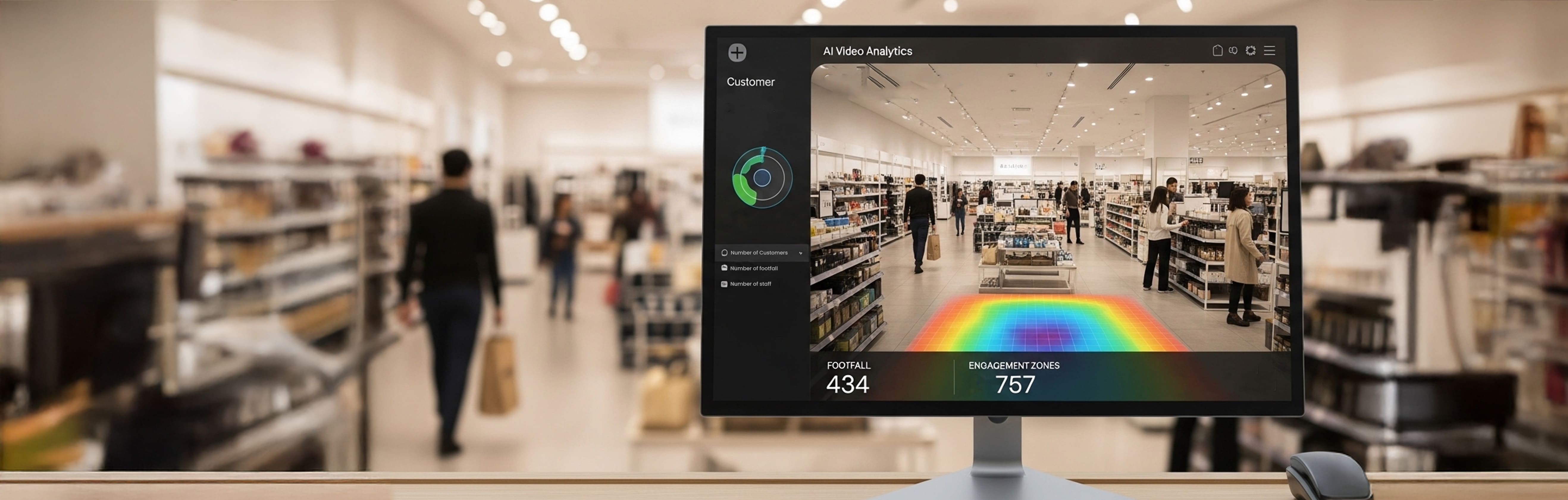
As per statistics only 2% of all CCTV footage ever recorded gets reviewed by human eyes. And that single statistic reframes everything across retail stores throughout the United States, cameras mounted at entrances, trained on aisles, positioned above checkout lanes. Where 98% of captured footage ages on a hard drive and gets overwritten before anyone looks at it. With a Traditional Security Camera the recording happens but the reviewing almost never does. Set that against this: U.S. retailers lost an estimated $45 billion to theft in 2024. Shrink has risen steadily to 1.6% of total sales, with projections pointing toward $53 billion in losses by 2027. Organized retail crime incidents jumped up to 57% in a single year. These numbers belong to an industry that, by every visible measure, is fully surveilled. The contradiction is not incidental. It is structural, at the same time expensive.
Why Business Security Cameras Were Never Built to Solve This
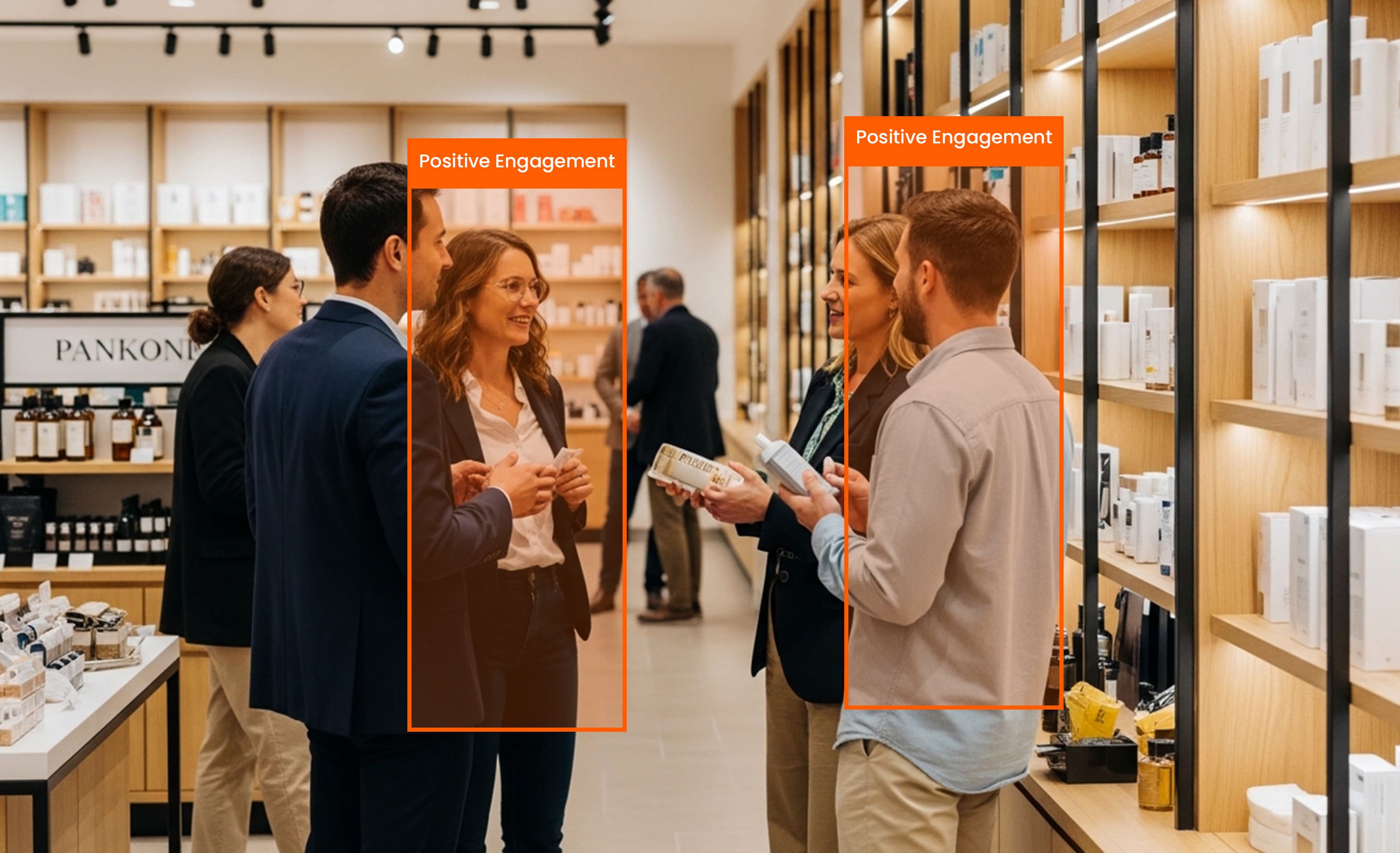
The version of this problem that gets misdiagnosed constantly are- retailers assuming that because cameras are running, the store is protected. What that assumption misses is the fundamental design limitation of conventional surveillance.
CCTV systems were engineered to document, not to intervene. They capture. They store. They produce a record of what happened, which is useful after “the incident” and nearly useless before it. No alert fires when a behavioral pattern suggests theft is imminent. No notification goes out when a staff member has quietly abandoned their section. No flag is raised when a queue has grown long enough to push customers towards the exit. These systems have no mechanism for any of that, because they were never designed with any of that in mind.
Research confirms the consequence: 64% of retail managers review footage only after an incident has already occurred. Just 12% review feeds more than once a week under normal conditions. For most U.S. retail operations, real-time human monitoring isn’t a strategic choice they’ve opted for, it is simply not feasible given staffing constraints and footage volume. Business security cameras, in their conventional form, are retrospective tools operating inside a problem that demands foresight.
The Intelligence Sitting Unused in Your Footage
What makes this genuinely costly isn’t just the theft that goes undetected, it’s the operational data that goes unread. Every customer who enters a store generates behavioural information: which areas they gravitate toward, how long they stay, where they stall, where they don’t. The distance between operators at the high end and the low end of that range is not usually explained by product selection or price point. It is explained by whether or not anyone understands what customers are actually doing inside the store, and adjusts accordingly.
Without retail video analytics, that understanding is unavailable. The footage capturing it is deleted on a rotating cycle. The same is true of staffing. Ghost shifts, peak-hour coverage gaps, and zone abandonment are endemic across retail at every scale. In the absence of structured, real-time monitoring, these failures surface through customer complaints or shrinkage audits, both of which are, by definition, too late. The cameras recorded every instance. The information never reached anyone positioned to act on it. For chain operators managing multiple U.S. locations, the problem multiplies. Each store becomes its own isolated data environment. Patterns that exist across the portfolio, shared vulnerabilities, recurring inefficiencies, systemic staffing problems, remain invisible because there is no unified layer capable of surfacing them.
What Shifts When Intelligence Enters the Picture
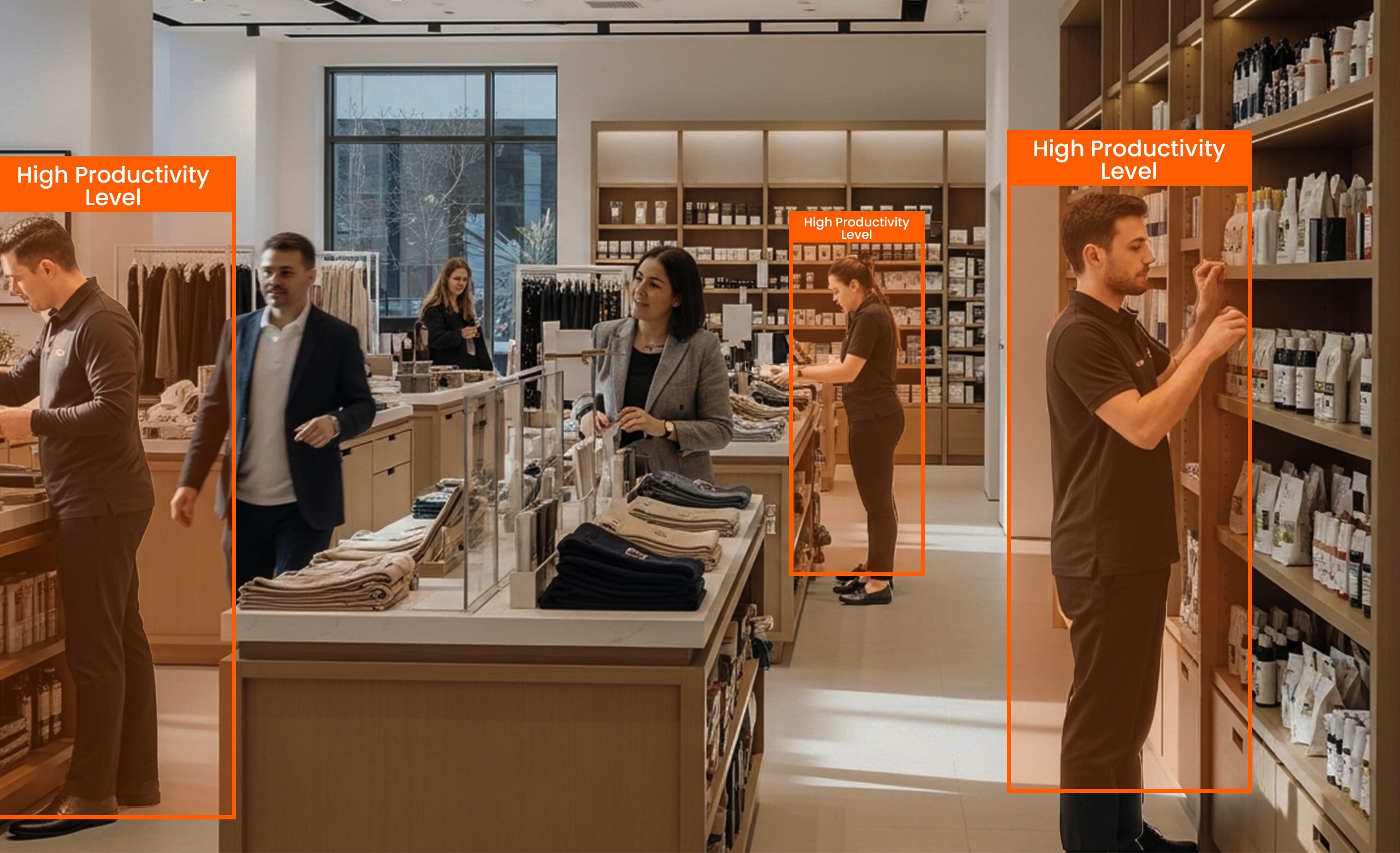
Intelligent video analytics does not ask retailers to rebuild their infrastructure. Rather it helps them to stop wasting the one they already have in their store. The technology enhances the existing camera systems by processing live feeds through an AI engine that detects, interprets, and responds in the real time. The footage that previously accumulated without purpose converts into a continuous stream of operational insight. A loitering pattern near high-margin merchandise triggers an alert. A checkout queue that has exceeded threshold wait times generates a floor staff notification before abandonment happens. Dwell-time data by zone informs layout decisions that were previously made on pure instinct.
The business analysis is not theoretical. AI-powered real-time monitoring has demonstrated theft reduction of up to 30% when integrated properly with in-store security operations. Retailers deploying advanced analytics have recorded inventory management improvements of comparable scale. And U.S. brick-and-mortar retail, a $5.93 trillion market in 2024, has historically operated without the behavioural data infrastructure that has given e-commerce a structural edge for years. An AI security camera layer closes that gap directly, using hardware that is already installed and already running.
How Jarvis Turns Existing Infrastructure Into a Business Asset
Jarvis is an AI-powered video and audio analytics platform, built specifically to extract the operational and security intelligence that standard surveillance leaves behind. It runs on computer vision, deep learning, and patented technology, converting live CCTV feeds into real-time alerts and structured analytics delivered through a centralized dashboard.
For retail operators, four platform capabilities matters the most:
Dynamic Video Wall brings every camera feed from every location into a single unified view. For multi-location operators, this is the practical difference between genuine oversight and a false sense of it.
Real-Time Alerts operate continuously across all feeds, flagging compliance violations, security anomalies, queue breaches, and zone gaps as they happen, not hours later when someone pulls the recording.
Ticket Management System which ensures that every alert moves through a defined escalation system. A detection system that produces no resolution is, operationally, equal to detection at all.
Retail Video Analytics, where covering footfall counts, demography, zone-level dwell time, and the conversion-adjacent behavioural data, gives physical store operators the same quality of customer insight that digital retailers are already using for smarter decisions about layout, staffing, and merchandising data.
The track record is concrete. India’s largest footwear retailer cut operational expenditure by 23% after deploying Jarvis. WeWork reduced capital expenditure significantly by layering Jarvis intelligence onto existing camera infrastructure, no hardware replacement, no operational disruption.
The Cost of Waiting
Every week a retail operation runs security cameras without an intelligent analytics layer, it is funding infrastructure that is delivering less than a fraction of its potential value. The footage accumulates. The patterns that go unread to track- The losses, inefficiencies, and missed optimizations compound. Not dramatically, but steadily this appears as a single line item but shows up everywhere in the numbers. Retail video analytics and intelligent video analytics are no longer emerging technologies being piloted at the edges of the industry. They are important operational tools delivering measurable outcomes for retailers who have chosen to stop treating surveillance as a checkbox and start treating it as a capability.
The cameras are already running. The question is whether they are working.
Book a Free Demo with Jarvis →
Frequently Asked Questions
Q1. What is intelligent video analytics, and how does it differ from standard CCTV?
Standard CCTV captures and stores footage without generating any active output. Insight only emerges if a human reviews the recording, often hours or days after the fact. Intelligent video analytics applies an AI engine to live feeds, detecting patterns, generating alerts, and producing structured operational data in real time. The hardware can be identical. What changes is what happens to the footage the moment it is captured, it becomes continuous, actionable intelligence rather than passive storage.
Q2. Does implementing an intelligent video analytics system require replacing existing cameras?
Not necessarily. Most modern intelligent video analytics platforms, integrate directly with existing camera infrastructure, including DVR and NVR systems already in operation. The AI intelligence layer is added on top of installed hardware, which means operators gain full AI capability without the capital expenditure of a hardware overhaul. For operators who have already invested in multi-location camera networks, this is a significant practical and financial advantage.
Q3. How specifically does an AI-powered camera system help with loss prevention?
Conventional cameras record incidents as they happen and provide evidence afterward. An AI-powered system identifies the behavioural indicators that precede a loss, unusual dwell patterns, repeated approach-and-retreat near high-value merchandise, exit monitoring anomalies, and generates real-time alerts that enable staff to intervene before a loss occurs. The core shift is from retrospective documentation to live intervention.
Q4. What can a retail video analytics platform offer beyond security?
A well-built retail video analytics platform delivers far more than loss prevention. Capabilities typically include unique visitor counts, zone-level dwell-time analysis, demographic data, queue monitoring, footfall trend reporting by hour and day, and staff compliance tracking. These give brick-and-mortar operators the same behavioral intelligence layer that e-commerce platforms have used to optimize customer experience for years, applied to physical stores through infrastructure they already own.
Q5. How long does deployment take across multiple locations?
Deployment timelines vary by platform and existing infrastructure. For most operators, the requirements are straightforward, existing cameras, a DVR or NVR system, and a stable internet connection. Once connected, an intelligent analytics engine begins generating insights almost immediately. JARVIS, for instance, is designed to go live within 30 minutes and consolidates all location feeds into a single Dynamic Video Wall from day one, making multi-location deployment operationally immediate.