How AI-Powered Video Analytics Can Transform a Cost Center into a Revenue-Generating Asset

AI investments are providing more tangible and faster returns than we thought. A majority of companies are spending between 11 and 30 percent of annual budget on warehouse technology with most spending on AI and machine learning that is driven by quantifiable improvements in accuracy of the inventory, throughput, labor efficiency and error reduction- the change is signaling experimental adoption transition to long-term capacity building. It has also resulted in 15-22 percent process efficiency improvement in the first year because of the workflow monitoring improvements that were made without adding to the number of employees.
These changes underscores a more profound change in the physical places like in the retail stores, warehouses, manufacturing plants, and the offices where business was always conducted without real-time view. Since companies are driving towards more quantifiable and information-based systems, automation no longer suffices but clarity is required.
It is in this area that AI-powered video analytics are becoming a critical layer, enabling organizations to transform mundane camera-captured video into operational intelligence and making it possible to predict, optimize, and scale more operations with a much greater level of accuracy.
Operational Cost Centers
Most of the revenue leakages in an offline space comes from what the managers or heads of operations can’t even point out since there is no clear data or clarity on what happens in the store . The most prevalent internal pain points are:
Store managers that use manual foot counts.
- Poor insight over customer movement trends.
- Inability to quantify the effects of campaigns in the physical location.
- Queues that emerge and take a long time to form.
- The teams responded to issues rather than foreseeing.
- Reports prepared manually, usually retrospectively.
Similar inefficiencies are experienced in factories and warehouses. In general, floor supervisors cannot keep track of worker productivity and safety compliance or bottlenecks as they occur. Slow pickups, packing or dispatching are not noticed in warehouses until it starts to influence the delivery schedule.
Even offline office arrangement is difficult to measure in terms of discipline and operational efficiency. The time in productive and unproductive work, presence measuring as well as process compliance are usually founded upon partial or manual processes that offer the prospect of inefficiencies that influence the whole performance.
Research indicates that more than three out of every four employees suffer presenteeism in which they are available in body but not in full strength and their unproductive work probably results in a loss of the productive work time by half.
How These Insights Become a Revenue-generating Asset AI-Powered Video Analytics?
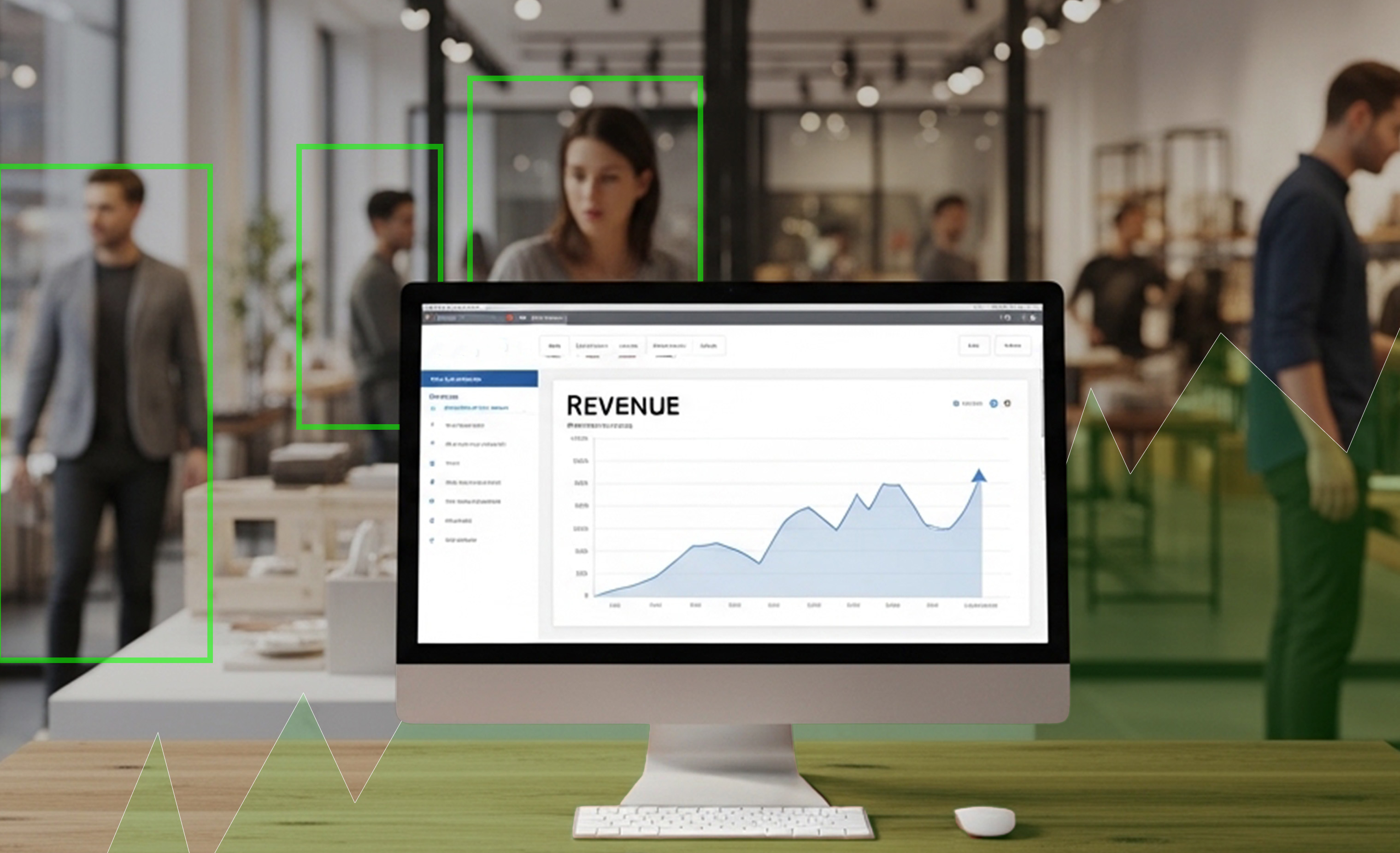
1. Footfall Counting
Among the most immediate revenue implications of AI-based video analytics is the ability to know the footfall pattern precisely.
The AI video analytics software can now enable companies to determine not only the number of people who have entered, but also the movement and location behavior of people. This is important for retails, warehouses and also offices.
Business improvements are:
- Determining the areas that perform well in the retail stores.
- Reorganizing the positioning of products depending on the engagement trends.
- Arranging the staff according to the actual traffic.
- Detecting the bottlenecks of the factory floors and optimizing the production flow in real time.
- Enhancing the warehouse operations through monitoring delay in picking, packing, and dispatch cycles.
- Improving office discipline by increasing visibility of the patterns of attendance, workspace usage and movement trends.
A 2026 retail research study conducted in Asia reveals that retail outlets with movement-based analytics were able to enhance layout efficiency and conversion rate by 18-27 percent post-redesign layout of stores using behavioral insights.
2. Line and Miniscule Changes
Long waits are not often complained about officially by customers, just these people leave or just do not come back. Queue patterns can be monitored in real time with AI video analytics software. Systems are able to estimate wait times, notify managers when the system becomes congested, and assist teams to redistribute staff before delays grow exponentially.
Even small gains are important. Improvement in the average wait time of 10-15 percent can lead to quantifiable improvements in transactions done, especially in high traffic retail and service facilities.
3. Marketing and Visibility in the Physical Space.
Accurate performance indicators have been the asset of online spaces, whereas the physical location was based on assumptions and AI-based Video analytics tool can help organizations to quantify and improve performance in any environment:
In retail:
- Traffic during promotions.
- Demographic trends.
- Repeat visits.
- Dwell time near displays.
In warehouses and factories:
- Zonal workflow efficiency.
- Time was taken at various levels of operation.
- Particular circulatory trends of goods and people.
In offices:
- The usage of workspace and meeting rooms.
- Hours spent on collaborative/unproductive.
- Interdepartmental movement patterns.
These insights help the marketing units to justify budgets better. They also reduce trial and error that has characterized offline campaigns.
4. Efficiency in the Workforce without Overloading Teams.
A significant amount of organizations have a problem striking the balance between efficiency and staffing costs. Bringing additional employees will address the issue of congestion but will raise overhead. Subject to delays in operations through the hiring of fewer staff.
Through AI-based video analytics, managers obtain an insight into the workflow pattern previously immeasurable.
Outcomes include:
- Optimized staff allocation
- Reduced idle periods
- Quicker reaction to production snarl-ups.
- Improved interdepartmental coordination.
In 2025, industry standards showed that organizations with structured workflow monitoring have reported an improvement in process efficiency of 15-22 percent in the first year yet these profits do not necessarily come with an increase in employees.
JARVIS and AI-Powered Video Analytics
When the implementation seems controllable, technology adoption becomes a fast process. Most organizations are reluctant to upgrade systems due to fears of interruption to routine business.
Applications such as Jarvis are not meant to substitute current camera systems but to integrate with them. This plug and play model enables organizations to start deriving insights out of their current systems without a lot of downtime or hardware upgrade.
The platform provides more than 100 data points on operational and behavioral measurements on the analytics. These include visitor counting, queue tracking, demographic analysis and workflow visualization which are available as centralized dashboards. When the accuracy of recognition on the system is over 99 percent on controlled datasets, the decision-makers can believe in automated insights.
Measure Better ROI With Jarvis
Efficiency patterns are often achieved quickly in the process of learning when it comes to AI-powered video analytics systems. The increase in revenue occurs more gradually while some operational savings might include:
- Less manual monitoring needs.
- Faster response times
- Reduce the costs of inefficiency.
- Better use of resources.
- Revenue benefits may arise on the basis of:
- Greater numbers of transactions are completed.
- Better customer experience.
- Better campaign targeting
- Efficient use of physical space.
According to one data, organized AI-based video analytics tools have proven its benefits to most companies a year after rollout. Two of the three companies that employed such systems realized real returns by mid-decade. Several months into the usage, improvement was noticeable even in industries that took up the technology. The fruits of their work were perceivable after one and a half years in most people who had adopted them.
Conclusion
The majority of the physical spaces lately are borrowing one of the major habits of digital sellers – following what works in reality based on the manner in which web stores operate. Their decisions are influenced by the sight of outcomes. Now choices come faster, more accurate since it is numbers that reveal what is real. Old habits are substituted with clear views. When improvement can be seen, responsibility increases.
Physical spaces are far, unlike digital networks, where artificial intelligence is used to monitor movement and activity. Since the days of retail stores to manufacturing factories, real-life places gradually turn into data-intensive ones. As the sight improves, the results tend to follow.
FAQs
1. How does AI-powered video analytics help improve ROI in physical spaces?
AI-powered video like JARVIS by Staqu turns video data into real-time insights, helping increase conversions, optimise resource utilisation, and enhance overall operational performance across physical spaces.
2. How can retailers improve staff productivity on the shop floor?
Video analytics provides visibility into staff movement, response time, and idle periods. This helps managers optimise task allocation and ensure better operational efficiency without increasing headcount.
3. What kind of business insights can video analytics provide?
JARVIS by Staqu can deliver insights across operations, including customer behaviour, workflow bottlenecks, queue trends, space utilisation, and safety compliance—helping businesses make more informed decisions.
4. How long does it take to see ROI from AI-powered video analytics?
Most organizations begin to see measurable improvements within the first year, depending on the scale of implementation and how effectively insights are used to optimise operations.
5. Which industries benefit the most from AI video analytics software?
Retail, manufacturing, infrastructure, logistics, public facilities, and smart city projects are among the industries seeing strong benefits.