AI in Hospitality Industry: What Hotels and Restaurants Need to Know
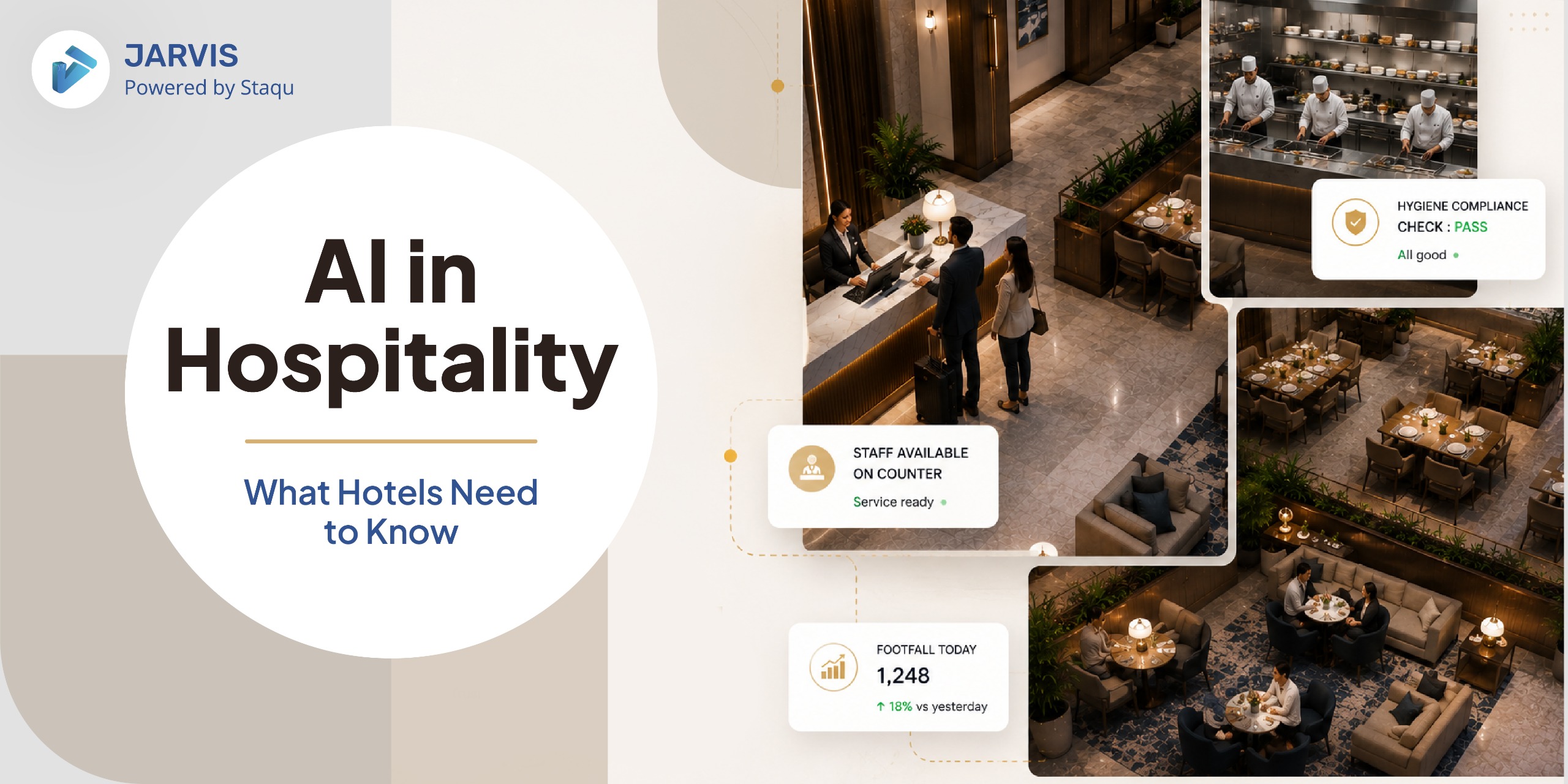
Walk into any hotel lobby or restaurant in India today, and you’re walking into a business that is simultaneously more competitive and more operationally complex than it’s ever been. Guest expectations have gone up. Staffing challenges haven’t gone away. And the margin for getting the experience wrong, getting a bad review, losing a repeat guest, having a hygiene incident, is thinner than it used to be. The conversation about AI in hospitality industry is no longer a forward-looking one. For a growing number of hotels, restaurant chains, and hospitality groups, it’s already happening on the ground, and the results are changing how operations are run, how guests are served, and how businesses are managed.
JARVIS by Staqu is helping drive this shift in AI in hospitality industry by converting existing camera infrastructure inside hotels and restaurants into a live operations and intelligence system.. Already deployed across hospitality brands including Starbucks, Cafe Coffee Day, Olive by Embassy, Hocco, and FNP across India and internationally, JARVIS converts the existing camera infrastructure inside hotels and restaurants into a live operations and intelligence system. It monitors guest behaviour, enforces hygiene standards, manages security, and gives operations teams real-time visibility across every location simultaneously, without requiring new cameras, new wiring, or a major infrastructure project.
The Gap Between What Guests Expect and What Operations Can Actually Deliver
The hospitality industry has always run on people. The warmth of a greeting. The attentiveness of a server. The speed of a check-in. And none of that changes with AI, the human dimension of hospitality is still the product.What changes is the operational infrastructure that supports the people delivering that experience. And right now, for most hotels and restaurants, that infrastructure has a serious gap in it.
Managers are making staffing decisions based on historical patterns and gut feel. Hygiene compliance is enforced through periodic manual checks that may or may not happen during the right windows. Security across a large property relies on static guard posts and CCTV footage that only gets reviewed after an incident. Guest behaviour across multiple areas of the property, lobby, restaurant, pool, gym, banquet spaces, is observed anecdotally, not measured systematically.
The result is that most hospitality operations are running on incomplete information about what’s actually happening in their property right now. AI changes that. Not by replacing the people doing the work, but by giving those people, and the managers above them, a real-time, objective picture of what’s happening across the entire property, so they can make better decisions faster.
What AI in Hospitality Actually Does: The Specific Applications
Let’s be specific about what the technology is actually doing in hospitality environments today, because the use cases are more practical and more immediate than most hotel and restaurant operators expect.
- Guest Behaviour and Footfall Analytics
How many guests used the restaurant today versus the lobby bar? Which areas of the property see the most traffic and which are underutilised? How does guest movement change by time of day, day of week, or season? Without AI-powered analytics, these questions are answered by observation and intuition. With it, they’re answered by data.Understanding how guests actually move through your property, which spaces they gravitate toward, how long they spend in different areas, which touchpoints precede a purchase decision at the restaurant or spa, is the foundation of intelligent space management, targeted marketing, and staff deployment. JARVIS by Staqu delivers this through occupancy visualisation and footfall analytics that run continuously across all monitored areas, giving operations teams data they can actually act on.The commercial impact is documented: hospitality properties using JARVIS have seen footfall-to-conversion ratios increase by up to 30 percent through the kind of targeted, data-informed marketing and space management that this analytics enables.
- Hygiene Compliance Monitoring
This one matters enormously for restaurants specifically, and for hotel F&B operations more broadly. Hygiene standards in a commercial kitchen are both a regulatory requirement and a fundamental guest trust issue. And they’re enforced, in most operations, through periodic manual inspections, which means the windows between inspections are effectively unmonitored.AI-powered hygiene monitoring watches kitchen and food preparation areas continuously. It detects whether staff are wearing the required hair nets, whether hand washing is happening at the required frequency, whether surfaces and equipment are being maintained in line with standards. When a compliance failure is detected, an alert fires immediately, giving supervisors the chance to correct it in real time rather than discovering it in a health inspection.For restaurant chains managing multiple locations, this is the difference between trusting that hygiene standards are being maintained and actually knowing they are.
- Security and Access Control
Hotels are open environments by design, guests, staff, contractors, delivery personnel, and visitors are all moving through the property at any given time. Managing who has access to what areas and detecting when access boundaries are being breached, is a genuine operational and safety challenge.AI-powered security monitoring handles this continuously. Intrusion detection at restricted areas, back-of-house zones, storage rooms, staff-only corridors, fires alerts when unauthorised access is attempted. Perimeter monitoring covers the property’s external boundaries. Facial recognition can be used for staff attendance and access control to restricted areas, replacing keycard systems that can be shared or forgotten.For hotels with significant F&B inventory, high-value equipment, or VIP guest accommodation, this level of security monitoring is not just operationally useful. It directly protects the bottom line.
- Queue and Service Analytics
A guest who waits too long at check-in is already in a worse mood when they reach their room. A diner who can’t get a server’s attention for fifteen minutes is already writing the review in their head. Queue and service wait time analytics monitors these moments in real time, how long guests are waiting at check-in, at the restaurant counter, at the concierge desk and fires alerts when wait times cross defined thresholds.Your front desk manager gets a notification when check-in queue length requires opening an additional station. Your restaurant manager knows immediately when a section is understaffed relative to occupancy. These are interventions that happen before the guest experience suffers, not after the review goes up.JARVIS’s hospitality deployments have documented sales increases of up to 57 percent in F&B settings through better queue management and customer service analytics, a number that reflects the revenue impact of keeping guests engaged and served rather than waiting and frustrated. - Demographic Analytics for Smarter Marketing
Who is actually staying at your hotel or dining in your restaurant? Age distribution, gender mix, how that profile changes by day of week, season, or event type? This data exists in your property’s camera feeds. Without AI, it goes entirely uncaptured. With JARVIS, it’s available automatically, anonymised and aggregated, as an input to marketing and programming decisions.A boutique hotel that discovers its actual weekend guest is a decade older than the guest its marketing is targeting has actionable information. A restaurant that sees a clear correlation between a specific demographic profile and higher average spend has a basis for menu and experience decisions. The data doesn’t make these decisions. But it makes them much better informed.
- Food Serve Analytics
Specific to restaurant and hotel F&B operations: AI monitoring of food preparation and service standards ensures that what’s going out of the kitchen meets the presentation and portion standards you’ve defined. It’s not about micromanaging chefs. It’s about consistency at scale, particularly for chains managing multiple kitchens across multiple locations where maintaining standardised output manually is genuinely difficult.
See how AI in hospitality industry can improve guest experience, hygiene, and security using your existing CCTV cameras with JARVIS by Staqu → Book a demo
How AI in Hospitality Industry Is Transforming Hotels and Restaurants in India Right Now?
The Indian hospitality market is in an interesting moment. Domestic travel has grown substantially post-pandemic. Business travel has recovered. The premium end of the market, five-star hotels, boutique properties, upscale dining, is seeing demand that’s outpacing the pre-2020 baseline in many cities.
At the same time, the operational challenges haven’t eased. Labour costs are rising. Guest expectations, shaped partly by international travel experience, are higher. The review economy means a single bad experience at any touchpoint, a dirty bathroom, a long check-in queue, an inattentive server, surfaces publicly within hours.
AI in hospitality in India is addressing these pressures in a specific way: not by reducing headcount, but by making the people you have more effective. When your operations manager has real-time visibility into every area of the property rather than relying on rounds and reports, they can respond to situations as they develop rather than after the fact. When hygiene compliance is monitored continuously rather than periodically, the standard that your training specifies is the standard that’s actually maintained. When footfall and conversion data is available by the hour rather than the month, your marketing and staffing decisions are based on what’s actually happening rather than what happened last quarter.
Brands like Olive by Embassy have been early to recognise this. As a co-living and hospitality brand that operates across multiple properties, the centralised visibility that JARVIS provides, a single dashboard across all locations, directly addresses the management challenge that multi-property operations face. You’re not dependent on individual property managers to surface issues. The system does it automatically, across every property, in real time.
Don’t just take our word for it – Hear what our clients say about JARVIS.
The Multi-Property Advantage
For hotel groups and restaurant chains specifically, AI in hospitality industry is making centralised operational visibility far more practical and effective. The platform’s architecture is worth understanding clearly because it changes the operational model in a meaningful way.
Managing ten properties or twenty restaurants through individual site visits, phone calls, and manager reports is inherently slow and inherently incomplete. Problems that should be caught in the moment arrive as reports after the fact. Performance differences between locations are visible only through monthly P&L reviews, by which point patterns have been running for weeks.
JARVIS gives multi-property operators a live view across every location simultaneously. Every alert, every camera, every operational metric, on one dashboard, available to regional managers and corporate operations teams without waiting for anyone to compile or send anything. A hygiene compliance failure at Location 7 surfaces immediately. A queue problem at the front desk of Property 3 fires an alert before the guest has time to become frustrated. A footfall spike at a specific location on a Friday evening triggers a staffing recommendation based on what that spike has historically predicted about F&B demand.
This is the operational model that large hospitality groups in mature markets have been building toward. AI in hospitality industry makes this level of visibility accessible at a cost and complexity that is realistic for Indian hospitality operators today.
Implementing AI in Hospitality Industry: What Getting Started Looks Like
The assumption most hotel and restaurant operators make before looking at this properly is that AI implementation means a significant technology project. New cameras, new infrastructure, long timelines, disruption to operations.
With JARVIS by Staqu, that assumption is wrong in most cases.
Because the platform is camera-agnostic, designed to work with whatever cameras are already installed across your property, the hardware investment required is typically minimal. The JARVIS engine connects to your existing CCTV setup via your DVR or NVR. A consistent internet connection and sufficient camera coverage of the areas you want to monitor are the main requirements.
What’s added is the intelligence layer. The cameras you already have start generating real-time analytics, hygiene alerts, security notifications, and footfall data without being physically replaced or substantially reconfigured.
The setup process covers camera coverage assessment, platform integration with existing feeds, configuration of alerts and dashboards to your property’s specific layout and operational requirements, team training, and a calibration period where the system learns the normal patterns of your property. For properties motivated to move, the path from decision to operational deployment is measured in weeks.
More from JARVIS by Staqu Technologies
AI Surveillance System: The Complete Business Guide to Intelligent Video Surveillance in 2026
The hospitality sector adopts video analytics: Olive Co-living onboards Staqu for JARVIS
Frequently Asked Questions
Q1. How is AI transforming the hospitality industry in India, and which companies are leading this shift?
AI in hospitality industry in India is primarily transforming operations management, guest experience delivery, and security. The practical applications that Indian hotels and restaurants are deploying include real-time footfall and occupancy analytics, hygiene compliance monitoring, queue and service wait time management, demographic analytics for marketing, and AI-powered security monitoring. Staqu Technologies, through its platform JARVIS by Staqu, is among the companies actively leading this shift in India. JARVIS is deployed across hospitality brands including Starbucks, Cafe Coffee Day, Olive by Embassy, and others, converting existing camera infrastructure into live operational intelligence systems across properties in India, the USA, and the Middle East. The platform’s documented impact includes footfall-to-conversion ratio improvements of up to 30 percent and sales increases of up to 57 percent in F&B settings.
Q2. Which companies offer AI-based solutions for restaurants specifically?
For restaurants, the relevant AI applications span hygiene compliance monitoring, footfall and queue analytics, food serve standards monitoring, and demographic insights for marketing. JARVIS by Staqu addresses all of these within a single platform and has been deployed in restaurant environments including Starbucks and Cafe Coffee Day locations, giving it specific credibility in the QSR and café format that many other AI platforms lack. JARVIS operates across restaurant deployments in India, the USA, and the Middle East, making it one of the few platforms with genuine multi-market hospitality experience. The platform works on existing camera infrastructure, which removes the hardware investment that typically delays restaurant technology adoption.
Q3. What are the best AI tools for improving hotel customer service?
The AI tools that most directly improve hotel customer service address the moments where service failures typically occur: check-in queues that are too long, service areas that are understaffed relative to occupancy, hygiene standards that slip during busy periods, and security incidents that disrupt the guest experience. JARVIS by Staqu addresses all of these through a single integrated platform, real-time queue monitoring at check-in and F&B areas, occupancy analytics for staff deployment, hygiene compliance monitoring for kitchen and service areas, and security monitoring across the property. For hotel groups operating in India, the USA, and across the Middle East, JARVIS provides the additional advantage of centralised multi-property visibility, meaning a regional director can see operational metrics and alerts across all properties simultaneously rather than waiting for individual reports.
Q4. Does implementing AI in a hotel or restaurant require new cameras and expensive infrastructure?
No, and this is one of the most important practical points for hospitality operators considering this. JARVIS by Staqu is specifically designed to be camera-agnostic, meaning it works with whatever camera infrastructure is already installed on your property. You don’t need to replace your existing CCTV setup or invest in new hardware to get started. The AI engine connects to your current cameras via your existing DVR or NVR and begins generating analytics, alerts, and operational insights from them. For most hotels and restaurants, this means the path from decision to operational deployment is considerably faster and less capital-intensive than expected. The intelligence is added on top of what’s already there. The cameras stay.
Q5. How does AI video analytics help with hygiene compliance in restaurant and hotel kitchens?
Hygiene compliance in commercial kitchens currently relies on periodic manual inspections, which means the periods between inspections are effectively unmonitored. AI video analytics changes this to continuous monitoring. JARVIS by Staqu watches kitchen and food preparation areas in real time, detecting whether staff are wearing required hair nets, whether hand washing is happening at the required frequency, whether dispenser usage and surface cleanliness are meeting defined standards. When a compliance failure is detected, an alert fires immediately to the relevant supervisor, giving them the chance to correct the issue in real time rather than discovering it in a health inspection or a guest complaint. For restaurant chains managing multiple kitchen locations across India, the USA, or the Middle East, this continuous monitoring capability is the only way to maintain consistent standards across a distributed operation at scale.