AI Surveillance System: The Complete Business Guide to Intelligent Video Surveillance in 2026
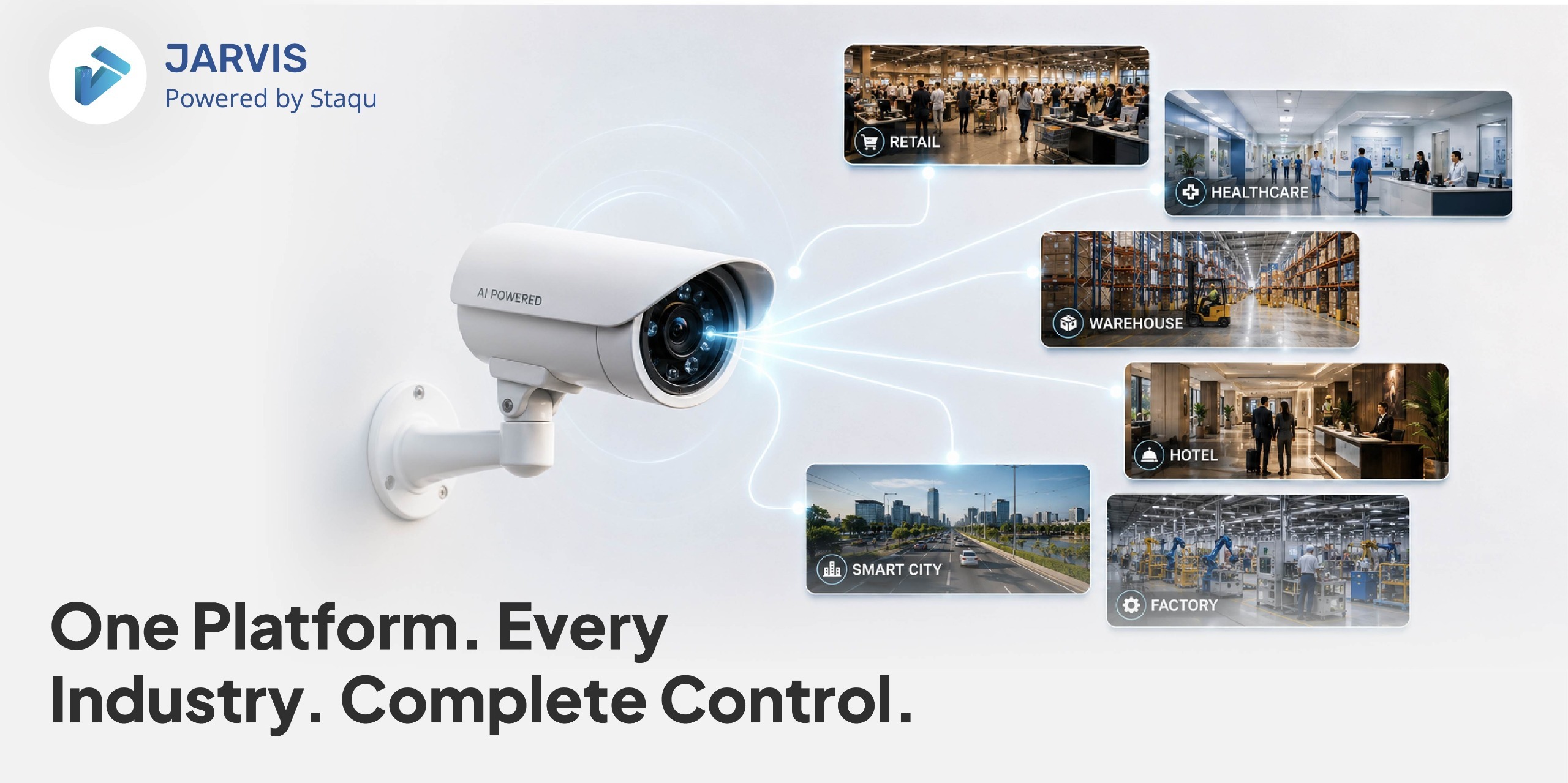
Here is something worth thinking about. Most businesses today have more cameras than before and less visibility than they realise. Teams rarely review footage until something has already gone wrong. That is the fundamental problem an AI surveillance system solves. AI adds intelligence to existing cameras by detecting important events and turning video into real-time insights.
AI surveillance and computer vision systems turn regular CCTV cameras into smart systems that provide real-time insights. Businesses across retail, healthcare, hospitality, logistics, manufacturing, and public infrastructure are adopting these systems to improve operations, safety, and decision-making.
JARVIS by Staqu Technologies is an audio-video AI surveillance system built to deliver enterprise-scale intelligence. It processes live video feeds from existing CCTV infrastructure and converts them into real-time alerts, operational dashboards, and structured business insights without requiring a hardware overhaul.
This guide explains how such systems work, which industries are adopting them, what the market data shows, and what businesses should evaluate before choosing a video analytics platform.
Why Businesses Are Investing in AI Surveillance Systems?
According to MarketsandMarkets (2024), the global AI video surveillance market is projected to reach USD 12.46 billion by 2030 at a 21% compound annual growth rate. This growth reflects a structural shift: organisations are no longer evaluating surveillance infrastructure purely from a security perspective. Video is becoming one of the most valuable operational data sources available.
The outcomes are measurable. SNS Insider research documents that AI-powered surveillance deployments have produced up to a 50% reduction in retail theft incidents, not through deterrence alone, but by detecting the behavioural patterns that precede theft, before an incident occurs.
Independent analysis from Infosys confirms that AI-driven operational monitoring improves store visibility and identifies recurring behavioural patterns linked to operational losses, shifting surveillance from reactive investigation to proactive operational intelligence.
JARVIS by Staqu delivers this intelligence across retail, healthcare, hospitality, and infrastructure.
See how JARVIS by Staqu works – book a 15-minute live demo →
What Is an AI Surveillance System?
Traditional CCTV systems are passive. They record. An AI surveillance system is active, analysing every frame, across every connected camera, simultaneously. A modern architecture operates through three layers:
1.Video input layer
Video feeds are captured through existing cameras that process data closer to the device. Enterprise-grade systems, including JARVIS by Staqu Technologies are camera-agnostic, meaning businesses continue using existing infrastructure while adding AI-driven analytics on top.
2. AI processing layer
Computer vision models process video frames continuously to identify customer movement and crowd density, queue formation and congestion, intrusion events and restricted-zone access, PPE compliance and safety violations, vehicle movement and ANPR detections, and behavioural anomalies outside defined parameters. Instead of simply storing footage, the platform converts video into machine-readable operational intelligence, the core distinction between an AI surveillance system and traditional CCTV infrastructure.
3. Intelligence and action layer
Once events are detected, the system generate alerts, tagged and searchable video clips, operational dashboards, compliance logs, and structured reports. These outputs reach security, operations, compliance, customer experience, and management teams all from the same video feed, without any manual review.
Key Industry Use Cases for AI Surveillance Systems
Retail and mall operations
Retail chains and mall operators use AI surveillance systems to measure customer behaviour, not just footfall.
The platform tracks movement through store zones, generates heatmaps of high- and low-engagement areas, and measures dwell time at displays. When a high-traffic area produces low conversions, the data makes the problem visible and actionable.
For loss prevention, the system identifies behavioural signals such as repeated restricted-zone access, unusual movement patterns, and activity during non-operational hours before incidents occur.
Healthcare facilities
Hospitals operate sensitive environments where delayed responses directly impact patient safety.
The platform supports:
- fall detection
- lone-worker alerts
- restricted-zone monitoring
- patient safety visibility
- queue management
For multi-location healthcare networks, centralized monitoring improves operational consistency across wards, emergency rooms, and patient areas.
Hospitality and QSR operations
Hotels, restaurants, and QSR brands use AI surveillance systems to enforce operational standards across multiple locations simultaneously.
The system detects:
- missing kitchen safety gears and violations
- fire hazards
- food serve analysis
- alcohol pilferage
- staff allocation
- guest area compliance violations
- cleaning and mopping
- footfall and demographics analysis
- occupancy analysis
- queue build-up
- perimeter security
It also generates automated compliance audit logs, reducing dependence on manual supervision.
Manufacturing, logistics, and warehousing
Industrial environments require monitoring across large operational spaces with complex safety requirements.
The platform supports:
- perimeter monitoring
- intrusion detection
- worker safety monitoring
- PPE compliance
- vehicle tracking
- ANPR-based access management
For logistics operators, ANPR integrations connect vehicle detections with visitor management systems, access-control platforms, and operational dashboards.
Public sector and smart city deployments
Cities, transportation networks, airports, and law enforcement agencies are among the fastest-growing adopters of intelligent video surveillance globally.
The platform supports:
- crowd density monitoring
- abandoned object detection
- perimeter intrusion alerts
- traffic analytics
- ANPR-based vehicle monitoring
Edge AI cameras are increasingly important in these environments because they reduce latency and improve processing speed across distributed infrastructure.
Why JARVIS by Staqu Technologies Outperforms Every Other AI Surveillance Platform?
Most of the AI surveillance software companies offer detection. Some offer detection plus alerts. Very few deliver what organisations actually need: structured, actionable intelligence that connects to business decisions.
The platform JARVIS is built by Staqu Technologies to do exactly that, and the architecture behind it is what makes it different from every other platform in the market.
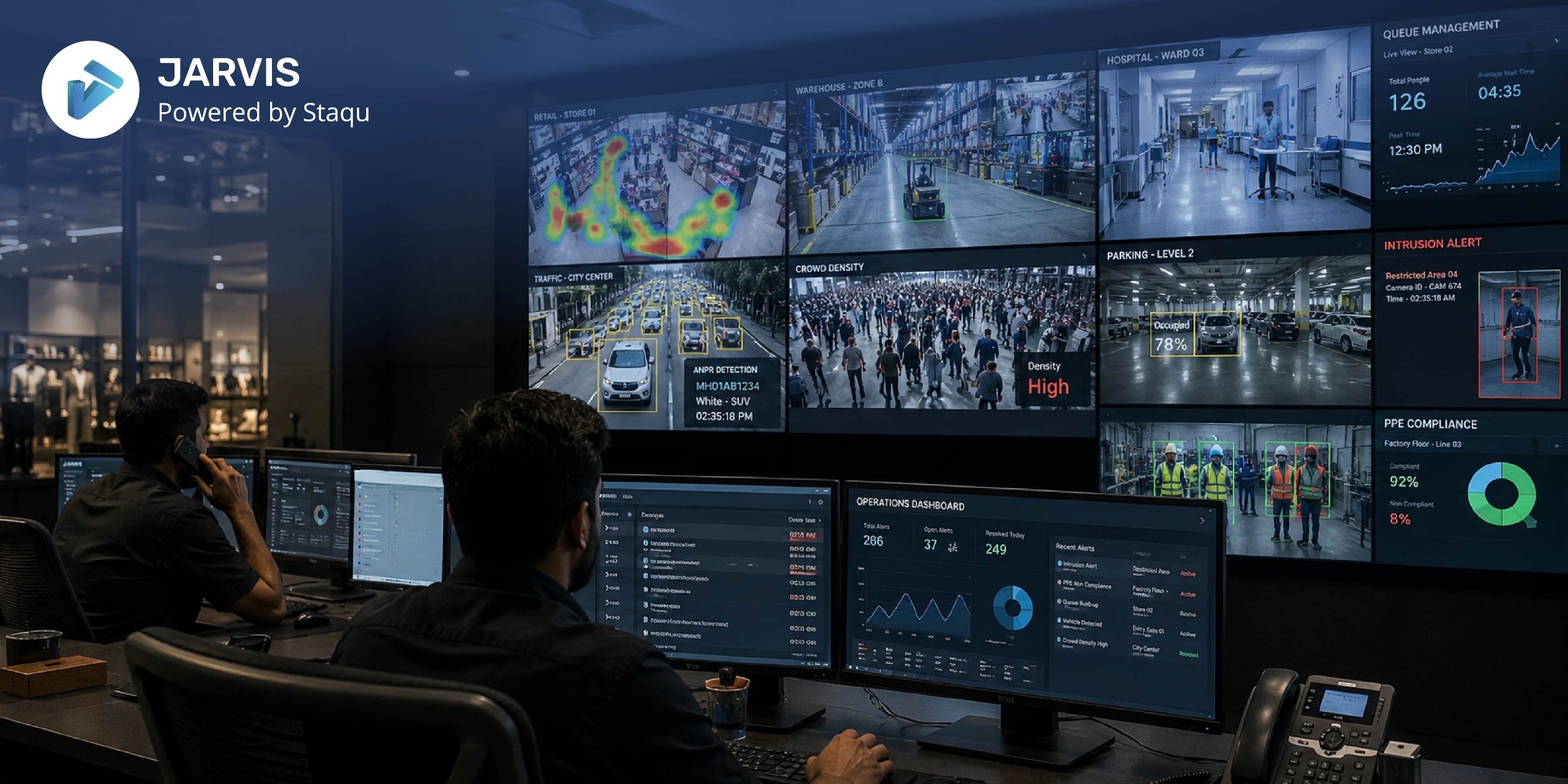
1. Centralized Monitoring with Cloud-Based VMS
Most surveillance platforms only display camera feeds. JARVIS delivers centralized operational intelligence.
Live feeds, alerts, recordings, analytics, compliance logs, and incident workflows are managed through a single cloud-based VMS dashboard, enabling businesses to monitor multiple locations remotely with complete operational visibilty.
2. Delivers business intelligence, not just security alerts
Most surveillance platforms generate alerts. JARVIS generates operational intelligence.
Footfall counts, zone heatmaps, queue analytics, compliance logs, and operational dashboards are generated from the same video feed.
3. Camera-agnostic, no forced hardware lock-in
Many surveillance vendors require proprietary hardware.
JARVIS works with all camera brands, allowing organisations to continue using existing CCTV infrastructure while adding AI-driven intelligence on top.
4. Integrates where decisions are made
The platform integrates with:
- ERP systems
- POS platforms
- access-control systems
- ANPR workflows
- compliance tools
This ensures alerts reach the right teams within the systems they already use.
5. Supports both centralised and edge deployment
JARVIS supports both centralized and edge deployment architectures.
In environments where bandwidth and latency are critical, edge AI processing reduces infrastructure load while maintaining real-time detection capability.
What to Evaluate Before Choosing a Video Analytics Platform?
Choosing an AI surveillance platform is no longer just a technology decision. It is an operational decision that affects scalability, security, compliance, and day-to-day visibility across the business.
Before selecting a platform, organisations should evaluate how well the system fits into their long-term operational environment, not just how many AI features it offers.
Deployment Scalability
Many surveillance systems work well in a single location but become difficult to manage at enterprise scale. Businesses operating across multiple sites should evaluate whether the platform can maintain consistent monitoring, reporting, and workflows across distributed environments.
Operational Relevance
Not every alert creates business value. The platform should generate insights that improve real operational outcomes such as customer experience, compliance visibility, safety management, and operational efficiency.
Ease of Adoption
Complex systems often create operational resistance. Businesses should evaluate how quickly teams can adopt the platform, navigate dashboards, access reports, and manage workflows without extensive technical dependency.
Infrastructure Flexibility
Enterprise environments vary significantly across industries and locations. A strong AI surveillance platform should support different deployment environments, camera ecosystems, and operational requirements without forcing infrastructure redesigns.
Long-Term Reliability
AI surveillance systems operate continuously across critical environments. Businesses should evaluate vendor maturity, deployment experience, AI model stability, and the ability to support evolving operational needs over time.
Data Visibility and Decision Support
The most valuable surveillance platforms do more than monitor incidents. They help organisations convert video into measurable operational intelligence that supports faster and more informed decision-making.
The Rise of Edge AI Cameras in Surveillance Infrastructure
Traditional surveillance architecture sends all video feeds to centralised servers for analysis. Edge AI cameras process parts of the data at the device level, enabling faster detection, lower bandwidth usage, and improved scalability across distributed infrastructure. As edge computing matures, edge AI surveillance deployments are increasing significantly across enterprise environments where large-scale centralised processing creates resource constraints.
JARVIS by Staqu supports both centralised and edge deployment architectures, giving enterprises the flexibility to optimise for latency, bandwidth, and operational scale based on their specific infrastructure requirements.
JARVIS by Staqu Technologies delivers this intelligence across retail, healthcare, hospitality, and infrastructure.
See how JARVIS by Staqu works – book a 15-minute live demo →
Conclusion
The surveillance industry is evolving rapidly, and the real value now lies in how intelligently cameras are used. An AI surveillance system transforms passive CCTV infrastructure into real-time operational intelligence, helping businesses centralize monitoring, improve compliance, strengthen security, and understand customer behavior. JARVIS by Staqu Technologies enables this with real-time video analytics and actionable insights, helping organizations turn every camera feed into measurable business outcomes.
Explore more from JARVIS by Staqu Technologies
How JARVIS by Staqu kept 40,000 IPL fans safe at Chinnaswamy Stadium
AI vs. Traditional Systems: A Complete Guide to Modern Retail Video Analytics Solutions
Frequently Asked Questions
What is an AI surveillance system?
An AI surveillance system uses artificial intelligence to analyze live camera feeds, detect events in real time, and generate alerts and insights without constant human monitoring.
What is the best AI surveillance system?
The best systems combine real-time analytics, centralized monitoring, scalable deployment, and enterprise integration. JARVIS by Staqu is built to deliver those capabilities across large organizations.
What is video analytics software?
Video analytics software applies AI to CCTV or video feeds to detect events, track movement, measure footfall, monitor compliance, and turn video data into useful insights.
How is JARVIS by Staqu Technologies different from other video analytics software?
Most platforms focus on detection alone. JARVIS goes further by combining surveillance, analytics, compliance monitoring, behavioral insights, and centralized dashboards in one platform.
Which industries use JARVIS by Staqu Technologies?
JARVIS is used across retail, healthcare, hospitality, corporate campuses, manufacturing, logistics, and public infrastructure.